

Indonesia’s labor market has transformed rapidly over the past few years, driven by tighter regulation and a more assertive approach to workforce governance. As recruitment falls under closer government scrutiny, job posting compliance has shifted from a technical HR task into a strategic business requirement — particularly for companies with foreign ownership or regional expansion plans.
How a vacancy is advertised, reported, and documented is no longer treated as an administrative detail. In Indonesia, job postings now function as a regulated gateway into the formal labor system, monitored by the Ministry of Manpower and local authorities. A single non-compliant listing can expose companies to administrative sanctions, audit risks, and reputational setbacks that extend far beyond the hiring process itself.
For foreign investors and business owners, this shift fundamentally changes the recruitment equation. Compliance is no longer just about avoiding penalties; it influences how regulators assess business legitimacy, how job seekers perceive employer credibility, and how smoothly operations scale across provinces.
This guide explains what lawful recruitment looks like in practice — from mandatory reporting obligations to anti-discrimination standards — while showing how modern HR systems can turn job posting compliance from a regulatory burden into a structural advantage.
The Legal Framework of Job Posting Compliance

Indonesia’s recruitment framework now rests on a simple but far-reaching premise: every open position must be visible to the state. Job postings are no longer treated as private employer activity, but as part of a national labor information system designed to track demand, protect job seekers, and guide workforce policy. This shift is anchored in a single regulation that now defines job vacancy reporting across Indonesia.
Presidential Regulation No. 57 of 2023: The Game-Changer
The legal foundation of Indonesia’s modern job vacancy reporting regime is Presidential Regulation No. 57 of 2023 (PR 57/2023), which officially replaced the decades-old Presidential Decree No. 4 of 1980. When it came into force on September 25, 2023, the regulation signaled a clear policy shift: job vacancy reporting would no longer be scattered and manual, but centralized under a national digital system.
PR 57/2023 fundamentally reshapes how employers manage recruitment. Every employer operating in Indonesia — regardless of size, ownership structure, or industry — is legally required to report job vacancies through a government-designated system.
This obligation is mandatory, not advisory. Failure to report vacancies affects a company’s compliance status and may trigger scrutiny during labor inspections.
Vacancies are now treated as formal labor market data that must align with national employment objectives — reinforcing the importance of job posting compliance from the outset.
Also read: Indonesia Labor Law: Key Rules for Foreign Business
Mandatory Vacancy Reporting to Digital Platform

To operationalize PR 57/2023, the government relies on the Manpower Information System, widely known as the Siap Kerja platform. Accessible via the Ministry of Manpower’s official portal, Siap Kerja functions as Indonesia’s central repository for job vacancy information.
Rather than acting as a conventional job board, the platform operates as a multi-layered labor ecosystem. Job seekers access verified opportunities, employers submit and manage vacancy data, local governments monitor compliance, and the Ministry of Manpower oversees national hiring trends. This structure reduces information gaps that historically limited access to employment, especially outside major urban centers.
By consolidating vacancies into a single system, Siap Kerja standardizes how jobs are presented and reported. For employers, this means recruitment visibility is no longer confined to private platforms. Once a vacancy is opened, it becomes part of the national labor database — making Siap Kerja registration a central pillar of compliant hiring.
Completeness and Accuracy of Vacancy Information
Compliance under PR 57/2023 depends not only on whether a vacancy is reported, but also on the completeness and accuracy of the information submitted. Employers are required to disclose sufficient detail to ensure transparency for both regulators and job seekers.
At a minimum, employers must report the following information:
- Employer identity — Full legal company name, registration details, and official contact information.
- Position details — Job title, number of openings, core responsibilities, and the validity period of the vacancy.
- Candidate requirements — Required education level, relevant skills, work experience, salary range, and work location.
- Vacancy status updates — Employers must update the system once a position has been filled or closed.
These requirements apply equally to domestic and overseas placements. International vacancies are subject to the same reporting standards, reflecting Indonesia’s commitment to comprehensive labor market oversight and reinforcing the broader framework of mandatory job posting compliance in Indonesia.
Also read: NPWP: Key to Tax Compliance in Indonesia
Non-Discrimination in Job Advertisements

Submitting a vacancy to the government system is only the starting point. Indonesia’s recruitment framework imposes substantive standards on how roles are described, candidates are evaluated, and hiring decisions are documented. Two areas — non-discrimination and record integrity — now sit at the center of enforcement.
In May 2025, the Ministry of Manpower issued Circular Letter No. M/6/HK.04/V/2025, reinforcing strict non-discriminatory hiring practices. The guidance targets job advertisements that filter candidates based on personal attributes unrelated to job performance.
Employers are expected to remove requirements based on age (unless objectively justified), gender, marital status, physical appearance, or other subjective characteristics. While the circular does not yet impose criminal penalties, it sends a clear regulatory signal: fairness and equal opportunity are baseline expectations, not optional ideals.
For foreign investors, this aligns closely with DEI and ESG recruitment standards. Discriminatory job postings can now trigger reputational risk long before formal sanctions appear. Given Indonesia’s regulatory trajectory, these principles are likely to be codified into binding rules with enforceable consequences — making compliant job descriptions essential to sustainable operations.
Consistency Between Job Postings and Employment Contracts
Compliance obligations extend beyond job advertisements into documentation and contract integrity. Under Indonesia’s employment law framework, companies must maintain recruitment and hiring records for at least five years after employment ends. These records may be requested during inspections or dispute resolution.
Required documentation includes job advertisements, applications, interview evaluations, and final hiring decisions. Together, they form the compliance trail demonstrating transparent and fair recruitment.
Equally critical is alignment between job postings and employment contracts. Advertised terms must match the contract issued after hiring, including job scope, location, wages, working hours, and employee rights. Any inconsistency may be treated as evidence of bad faith or misrepresentation, exposing employers to disputes and regulatory action. This alignment is a core element of effective HR compliance Indonesia.
Also read: Employment Types in Indonesia: Contracts and Regulations
Foreign Hiring and RPTKA Alignment

Recruitment decisions are assessed not only for legal compliance, but also for alignment with national workforce priorities — particularly when expatriate talent is involved.
Companies intending to hire foreign nationals must obtain approval for a Foreign Worker Utilization Plan (RPTKA). The plan verifies that foreign expertise is genuinely required and that the role cannot reasonably be filled by an Indonesian worker.
In practice, most sectors apply a 1:10 localization ratio — one foreign worker for every ten Indonesian employees. Certain industries face stricter controls due to their strategic or safety-sensitive nature.
This requirement directly affects recruitment communication. Job postings must align with roles approved under the RPTKA and clearly demonstrate preference for local talent where applicable. Misalignment between postings and approved plans is a common trigger for compliance issues during inspections.
Also read: Recruitment of Foreign Workers Regulation Indonesia: A Complete Guide
Workforce Development and Knowledge Transfer
Beyond headcount ratios, Indonesia emphasizes long-term workforce development. Foreign-invested companies are expected to contribute to skills transfer and capacity building among Indonesian employees.
This expectation should be visible in hiring strategy and job descriptions. Roles involving expatriates are typically expected to include mentoring or structured knowledge transfer. Clearly articulating these elements in postings supports foreign worker recruitment Indonesia compliance while signaling alignment with national human capital objectives.
Non-Compliance: Understanding the Consequences

Indonesia’s enforcement approach has evolved, but the consequences of ignoring recruitment obligations remain significant. The government now prioritizes compliance correction, while retaining strong tools for persistent violations.
Administrative Sanctions Framework
PR 57/2023 introduces a modern enforcement model focused on administrative measures. Employers who fail to report vacancies or submit incomplete data receive formal warnings, placing them under closer monitoring.
Conversely, consistent compliance may be formally recognized through certificates issued by the Ministry of Manpower or local governments. While not mandatory, these recognitions function as reputational assets for investors and partners.
Specific fine amounts are still being finalized, but the policy direction is clear: voluntary compliance is encouraged, while repeat offenders face escalating consequences.
Broader Labor Law Risks
Recruitment violations can escalate into broader labor law exposure. Authorities may impose permit restrictions, suspend business licenses, or pursue criminal sanctions for severe cases. Financial penalties can reach Rp 1 billion, alongside mandatory BPJS compliance obligations. In this context, job posting compliance functions as an early safeguard against wider operational risk.
Also read: The Good, The Bad, The Ugly: Work Culture in Indonesia
Why Job Posting Compliance Is a Business Advantage

For foreign investors and business owners, job posting compliance should not be viewed purely as a defensive obligation. When embedded into recruitment workflows, it becomes a structural advantage.
Access to broader talent pools
By reporting vacancies through the Siap Kerja system, employers connect directly with millions of active job seekers across Indonesia. This visibility extends well beyond conventional recruitment channels, allowing companies to reach regional and emerging talent markets that are often missed by private job boards or referral-driven hiring.
Building institutional trust
Consistent adherence to labor regulations signals operational maturity to government authorities, helping reduce friction during inspections, licensing processes, or future expansion approvals. The same signal resonates with job seekers, who increasingly associate regulatory compliance with employer credibility, stability, and professional governance.
Improving operational efficiency
Centralized reporting through government platforms removes the need for fragmented submissions across multiple provincial or district offices. When combined with structured HR workflows, this approach reduces duplication, minimizes administrative errors, and shortens overall hiring timelines.
Strengthening risk mitigation
Companies that embed compliance into their recruitment processes shield capital from avoidable exposure — whether in the form of fines, license suspensions, or operational disruptions. In tightly regulated labor markets, predictability and procedural clarity become competitive advantages in their own right.
Also read: A Startup’s Guide to Payroll Outsourcing in Indonesia
Best Practices for Job Posting Compliance

Effective compliance spans the entire recruitment lifecycle.
Before posting, employers should ensure job descriptions reflect real operational needs, remove subjective criteria, and align postings with employment contracts and RPTKA approvals. Documentation should be prepared from the outset.
During posting, vacancies must be registered on Siap Kerja, application status kept current, and all evaluations documented systematically. Centralized recruitment systems help maintain consistency and traceability.
After hiring, employers must update vacancy status, retain records for five years, and archive documentation in audit-ready formats. This lifecycle approach strengthens long-term recruitment compliance Indonesia.
Evolving Compliance Landscape
Indonesia’s labor regulatory framework remains under development. Implementing regulations for PR 57/2023 are still forthcoming, and employers should expect clearer penalties, tighter procedures, and stricter timelines.
Anti-discrimination principles are likely to become more detailed and legally binding. Technology integration may deepen, potentially requiring direct links between corporate HR systems and the Siap Kerja platform. At the same time, ESG expectations will continue to shape how recruitment practices are evaluated by investors and regulators alike.
Also read: The Benefits of Using Payroll Outsourcing Services in Indonesia
Streamlining Job Posting Compliance

Keeping pace with Indonesia’s recruitment regulations requires more than manual checklists. Companies need integrated HR systems that can manage compliance, documentation, and hiring workflows in one place — without slowing growth.
Modern recruitment platforms help standardize job descriptions, enforce non-discrimination requirements, track candidates systematically, and maintain audit-ready records. When recruitment tools connect directly with payroll and core HR systems, employers eliminate data silos and ensure consistency from hiring through onboarding, tax, and BPJS administration.
Cloud-based systems add further value by providing real-time regulatory updates, remote accessibility for distributed teams, and built-in audit readiness.
Gadjian: Indonesia’s Best Talent Acquisition Software for All Businesses
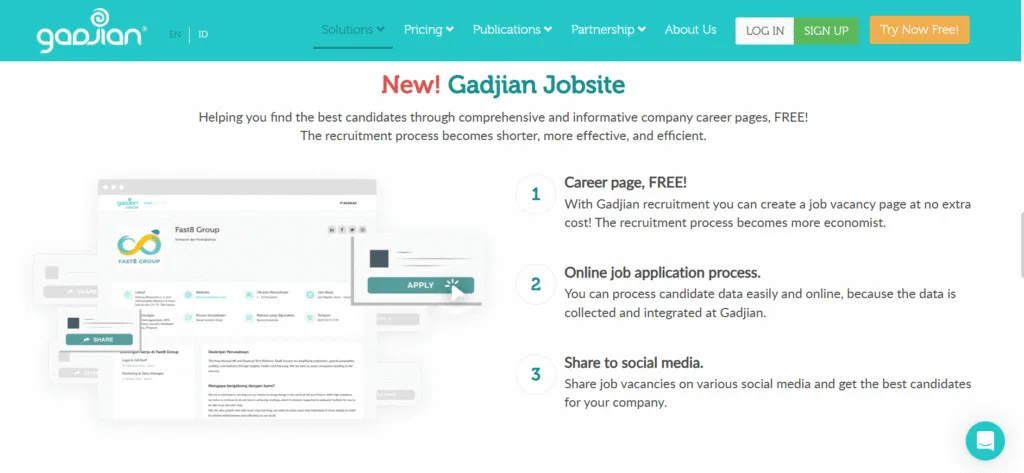
For companies hiring in Indonesia — especially across multiple locations — Gadjian offers an integrated HR platform designed around local regulatory realities. Through its Applicant Tracking System (GATS), employers can manage the full recruitment lifecycle in a single cloud-based environment, from job posting to final hiring decisions.
GATS centralizes candidate data, streamlines application handling, and enables transparent collaboration across hiring teams — while keeping documentation structured and inspection-ready. To lower adoption barriers, Gadjian also provides free job posting features, including a company career page and unlimited listings during the initial usage period, allowing businesses to start systematically and scale as hiring needs grow.
What sets Gadjian apart is its end-to-end integration. Once candidates are hired, their data flows directly into payroll, tax (PPh 21), BPJS, attendance, and employee self-service systems — reducing duplicate data entry and minimizing compliance risk across the employee lifecycle.
Bisadaya: Inclusive Hiring Support
For companies pursuing inclusive and ESG-aligned recruitment, Bisadaya complements employer-side systems by connecting organizations with underrepresented talent segments, including people with disabilities, seniors, freelancers, and gig workers. Its AI-based matching approach helps employers expand access to talent while strengthening employer credibility.
In Indonesia’s evolving labor landscape, recruitment compliance is no longer just about avoiding penalties — it defines how credible, scalable, and investable a business becomes. With the right systems in place, compliance shifts from a regulatory burden into a foundation for sustainable growth.
Gadjian helps you build that foundation — clearly, efficiently, and in line with Indonesia’s hiring regulations.