

Foreign investors see Indonesia as one of Asia’s most promising growth markets. However, foreign company expansion in Indonesia is often undermined by avoidable HR mistakes. Complex labor laws, region-based minimum wages, mandatory social security schemes, and a distinct work culture create risks that many global playbooks simply do not anticipate.
This report highlights the most common HR missteps foreign firms make when entering Indonesia and outlines practical ways to avoid them.
Indonesia Is Attractive—but Risky—for Foreign Company Expansion

Indonesia is the world’s fourth-most-populous country and Southeast Asia’s largest economy, with a young workforce and a rapidly growing middle class.
At the same time, its regulatory framework is dense. Companies must navigate Manpower Law No. 13/2003 as amended by the Job Creation Law, implementing regulations on contracts and termination, provincial and district minimum wages, and mandatory BPJS social security schemes.
For foreign companies without local HR expertise, missteps in contracts, benefits, or terminations can escalate into disputes, fines, or reputational damage. Labor protections, documentation requirements, and audit standards make compliance significantly more complex than in many developed markets.
Common issues include incorrect or missing written contracts, misclassification of workers, underpayment of minimum wages, late or inaccurate statutory payments, and improper termination procedures.
Also read: Pros and Cons of HR Outsourcing in Indonesia
Why HR Is Central to Foreign Company Expansion Success

Foreign company expansion is often driven by market opportunity, tax incentives, and growth projections. However, in Indonesia, execution risk sits heavily within HR and employment compliance. Labor regulations, wage structures, statutory benefits, and termination rules directly affect cost structure, operational flexibility, and reputational exposure.
Unlike in some markets where HR can be standardised across regions, Indonesia requires localised contracts, payroll systems, and documentation practices. A misstep in employment classification, BPJS registration, or payroll tax withholding can escalate into disputes or regulatory scrutiny.
For this reason, HR is not merely an administrative function during foreign company expansion—it is a structural pillar. Companies that embed compliant HR frameworks from day one tend to scale faster, avoid costly corrections, and build stronger employer credibility in the Indonesian market.
Also read: Job Posting Compliance for Hiring in Indonesia
Critical HR Mistakes That Derail Foreign Company Expansion in Indonesia

In Indonesia, HR missteps are rarely minor administrative oversights—they can materially affect cost, scalability, and legal exposure. Below are the most frequent HR risks that undermine foreign company expansion and how they typically manifest in practice.
Hiring Without a Legal Employer Structure
One of the most frequent errors in foreign company expansion is trying to hire Indonesian staff directly without a locally registered entity.
Indonesian law generally requires employers to have a legal presence in the country—such as a PT PMA (foreign-owned limited liability company)—to enter into employment contracts and fulfil statutory obligations. Without such an entity, foreign firms cannot legally be recognised as employers and may breach employment and immigration rules.
Investor guides note that some companies attempt to bypass these requirements by using freelance contracts or paying staff from overseas entities. This approach creates risks related to employment status, tax withholding, and social security compliance.
A more sustainable route is to either establish a local entity early or use an Employer of Record (EOR) in Indonesia or a PEO model to host employees compliantly during the market-entry phase.
Employment Law Risks in Foreign Company Expansion
Indonesia’s labor law framework governs contracts, working hours, leave, overtime, termination, and benefits in considerable detail. Employers must choose between indefinite-term contracts (PKWTT) and fixed-term contracts (PKWT), each with different rules on duration, renewal, and termination.
For example, PKWT contracts are limited in total duration—typically up to five years including extensions—and are meant for specific kinds of work. Misusing them for permanent roles can trigger reclassification and additional severance obligations.
Foreign companies unfamiliar with these categories often rely on generic global templates that do not reference Indonesian law, omit mandatory clauses, or fail to specify job scopes and working locations clearly. This creates ambiguity when disputes arise and may render parts of the contract unenforceable.
Local guidance emphasises the importance of written contracts, clear classification between PKWT and PKWTT, and alignment with updated Job Creation Law provisions.
Ignoring Regional Minimum Wage and Pay Structure Rules
Indonesia’s minimum wage system is set at the provincial—and in some cases district—level, rather than nationally. Regional minimum wages (UMP/UMK) are updated annually, with increases typically ranging from 3–6%, depending on local economic indicators.
Employers must ensure that base salaries for employees in each region meet or exceed the applicable minimum wage where the employee actually works—not just where the company’s head office is located. Foreign firms that centralise pay decisions offshore sometimes overlook these regional differences, leading to inadvertent underpayment of staff in higher-cost areas like Jakarta.
On top of this, regulations on wage structure and scale require employers to document structured pay ranges across job levels, a concept closely related to salary bands and internal equity. Failing to implement compliant structures can create both legal and employee-relations problems.
Underestimating BPJS and Statutory Benefits
Another common trap in Indonesia HR compliance is mishandling BPJS—Indonesia’s mandatory social security system.
Employers must register eligible employees in BPJS Ketenagakerjaan (social security) and BPJS Kesehatan (healthcare) and pay both the employer and employee portions of contributions each month. Contribution rates vary by program (JHT, JKK, JKM, JP, and JKP) and are calculated as a percentage of wages, subject to statutory caps.
Foreign-owned companies (PT PMA) that treat BPJS as optional benefits or delay registration risk penalties, blocked licensing processes, and employee dissatisfaction. Recent commentary notes rising enforcement, with participation rates increasing significantly over the past five years as authorities tighten oversight.
A robust payroll management process in Indonesia must therefore integrate BPJS calculation and payment alongside net pay, not treat it as an afterthought.
Miscalculating PPh 21 Payroll Tax
PPh 21, the Indonesian personal income tax on employment income, is another source of mistakes for foreign employers. The system has undergone changes in recent years, including the move to NIK-based NPWP numbers and the introduction of effective tax rate (TER) tables that simplify monthly withholding but require careful implementation.
Errors typically arise when global payroll teams apply foreign tax logic to Indonesian employees, ignore non-taxable components, or mis-handle annual adjustments in December. Miscalculated PPh 21 leads to under/over-withholding, creating headaches at year-end and undermining employee trust.
Best practice is to use localised systems or providers that embed current PPh 21 rules and formats (including Coretax reporting) into their calculations.
Cultural Misalignment in Foreign Company Expansion
Work culture misalignment can quietly undermine global expansion HR strategy even when contracts and payroll look correct on paper.
Indonesia scores high on power distance and collectivism, with strong emphasis on hierarchy, team harmony, and indirect communication. Employees often expect leaders to provide clear direction and may avoid directly challenging or contradicting superiors in group settings.
Foreign managers who bring a confrontational or overly individualistic style may unintentionally create fear or disengagement. Local guidance for foreigners stresses the importance of building trust through relationship‑oriented leadership, showing respect for titles and seniority, and delivering criticism in private rather than in public forums.
Ignoring these norms is not illegal. But it can significantly affect retention and performance—especially when running Indonesian remote teams where misunderstandings are easier to miss.
Applying One-Size-Fits-All Remote and Hybrid Policies
Post‑pandemic, Indonesian professionals increasingly expect some degree of flexibility, but hybrid and remote models here do not mirror Western norms.
Connectivity, housing conditions, and family dynamics differ widely, and many roles still rely on in‑person coordination. Yet some foreign HQs roll out global remote work policies that assume uniform broadband, home office setups, and communication styles.
When employees work remotely across cities and islands, time zone coordination, asynchronous communication, and attendance tracking become more complex.
Without localised HR processes, companies struggle to manage this complexity. They often lack Indonesian-compliant attendance records, proper overtime tracking, and structured leave management. This makes audit documentation harder and creates inconsistencies between remote and office staff.
Running HR and Payroll on Spreadsheets
Many foreign companies begin their Indonesian operations with a handful of staff and simple spreadsheets. This may work temporarily, but it quickly breaks down as headcount and regulatory demands increase.
Indonesia’s regulatory environment demands tight coordination across contracts, attendance, payroll, tax, and BPJS reporting. Relying on manual tools increases the risk of missed updates and costly input errors.
Analyses of HR outsourcing Indonesia trends highlight that foreign investors increasingly outsource payroll and compliance functions to reduce this risk. A structured HRIS tailored to Indonesian regulations not only reduces errors but also gives management better data for decisions on hiring, promotions, and expansion.
Also read: Employment Types in Indonesia: Contracts and Regulations
How to Derisk Foreign Company Expansion in Indonesia

Successful foreign company expansion in Indonesia requires proactive legal structuring, compliant HR systems, and culturally informed leadership from the outset.
Build Local Legal and HR Expertise Early
For any serious foreign company expansion, engaging local legal and HR advisors early is non‑negotiable. They can interpret evolving regulations (such as Job Creation Law changes, new wage structure rules, and BPJS updates) and help design compliant employment frameworks. Companies that lack internal scale often rely on EOR/PEO or HR outsourcing during their early years.
Standardise Employment Contracts and Pay Structures
Develop Indonesian‑specific contract templates that distinguish PKWT and PKWTT, include mandatory clauses, and reflect realistic probation, working hours, and termination conditions. Align these contracts with documented salary structures and pay scales so that minimum wage compliance, internal equity, and promotion paths are clearly defined.
Payroll Compliance in Foreign Company Expansion
Avoid retrofitting global payroll tools. Use systems that natively support PPh 21 rules, BPJS contributions, and Indonesian reporting formats. This ensures that tax tables, contribution caps, and identifiers (like NIK‑based NPWP) are kept up to date and applied correctly.
Respect Cultural Norms While Maintaining Standards
Train non‑Indonesian leaders on local work culture—hierarchy, communication styles, and expectations around feedback and social interaction. Set clear performance standards but deliver coaching in culturally aware ways, leveraging group‑oriented recognition and private corrective conversations.
Use Technology Built for Indonesia
Investing in a locally designed HRIS reduces compliance risk and improves transparency for both local staff and global leadership. The right system integrates employee data, contracts, attendance, payroll, tax, social security, and analytics into one environment tuned to local law.
Investing in the right systems and local expertise is not just about avoiding penalties. It is about building sustainable operations from day one. Once structural risks are clear, execution becomes the real test: how to operationalise compliant HR at scale.
Also read: Recruitment of Foreign Workers Regulation Indonesia: A Complete Guide
Why Gadjian Supports Foreign Company Expansion in Indonesia

Expanding into Indonesia requires more than market insight—it requires systems structurally aligned with local law. Gadjian is designed specifically for the Indonesian regulatory environment, embedding local employment, payroll, tax, and social security regulations directly into its core architecture. Instead of retrofitting global tools, companies can operate on infrastructure designed for Indonesia from day one.
Localised Employee and Pay Structure Management
Gadjian’s Employee Wage Structure and Scale System helps foreign companies design salary structures that comply with Permenaker No. 1/2017. Automated grading tools and structured pay bands support minimum wage compliance and internal equity. They also create defensible compensation frameworks that reduce exposure during audits or labor disputes.
The HR master data system supports multi-entity setups and flexible organisational charts. This structure suits foreign groups that manage multiple subsidiaries or branches across Indonesia.
End-to-End Payroll, PPh 21, and BPJS Automation
Payroll errors are among the most common compliance failures during foreign company expansion. Gadjian automates wage calculations, overtime, bonuses, deductions, payslips, and payroll recaps—eliminating spreadsheet dependency.
Integrated PPh 21/26 modules align with current Indonesian tax rules. The system automatically calculates BPJS Ketenagakerjaan and BPJS Kesehatan contributions and updates them when regulations change. This significantly reduces regulatory risk and year-end reconciliation issues.
Operational HR for Onsite, Hybrid, and Remote Teams
As foreign companies adopt flexible workforce models, compliance becomes more complex—not less. Gadjian integrates shift scheduling, leave approvals, overtime workflows, and payroll in one system. It ensures consistent employee treatment across locations and work models.
Through the Gadjianku mobile app, employees can access payslips, submit leave, and manage personal data independently. The app improves transparency while reducing HR administrative burden.
Analytics That Support Strategic Growth
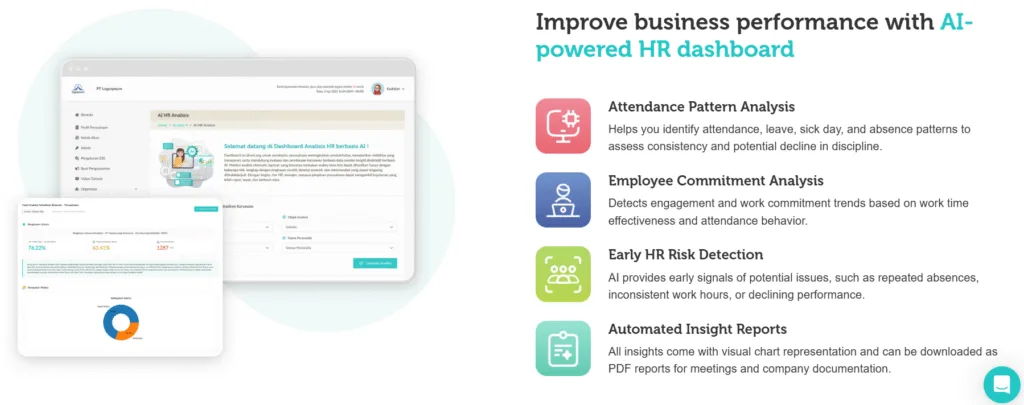
Beyond compliance, Gadjian transforms HR data into decision-grade insight. Leadership teams gain visibility into headcount trends, compensation structures, and performance evaluations. With clearer data, foreign HQs can better align Indonesian operations with their broader HR strategy and expansion plans.
Also read: Common Payroll Errors in Indonesia and How to Fix Them
HR & Payroll Outsourcing: A Practical Alternative with Pegawe
Not every foreign company entering Indonesia wants to build internal HR infrastructure immediately. For businesses that prioritise speed, efficiency, and minimal administrative exposure, outsourcing HR and payroll can be a strategic solution.
Pegawe provides end-to-end HR & payroll outsourcing services designed specifically around Indonesian employment regulations. Foreign companies can avoid handling statutory tax, BPJS, documentation, and reporting requirements internally. Instead, they can delegate these operational tasks to local specialists.
What Pegawe Delivers
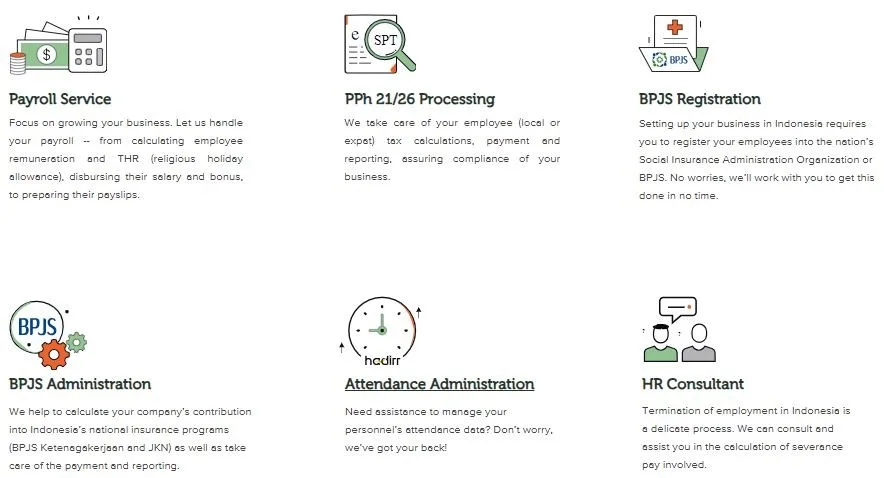
- End-to-end payroll administration, including salary, bonuses, THR, and payslip generation
- PPh 21/26 calculation, remittance, and reporting
- BPJS Ketenagakerjaan and BPJS Kesehatan registration and contribution management
- Attendance documentation and HR administrative compliance
- Recruitment support and EOR services for compliant workforce hosting
Many foreign companies want operational certainty without expanding internal headcount. Pegawe provides a compliant, locally managed infrastructure that reduces regulatory risk while keeping things efficient.
You can choose a technology-driven platform like Gadjian or a fully managed outsourcing solution with Pegawe. Both help you reduce compliance risks and scale your HR operations in Indonesia.
Your business expansion should be built on regulatory certainty—not guesswork. The right local partner ensures your growth strategy is supported by compliant, resilient, and future-ready workforce management.