
When foreign companies expand into Indonesia, the operational question appears quickly: How do we maintain accountability without being physically present? On paper, the answer seems simple—deploy productivity monitoring software.
Yet, in practice, managing Indonesian remote teams demands a deeper grasp of local realities. You cannot simply install a global tracking tool and switch it on.
Connectivity outside major urban centers can be inconsistent. Time zone differences create reporting delays. Cultural norms shape how employees communicate performance challenges. A tool designed for Western office environments does not automatically translate well into the Indonesian context.
This is why many international companies discover that generic productivity monitoring software feels rigid or misaligned once implemented locally. What they need is not just tracking—but structured visibility that respects legal, cultural, and infrastructural realities.
Indonesia Remote Work Trends

Remote and hybrid work adoption accelerated significantly after the pandemic, particularly across services, technology, and sales-driven sectors. During the height of COVID-19 restrictions, the proportion of Indonesians working remotely rose from around 4% pre-pandemic to approximately 13%. It marks a structural shift in how companies approached workforce flexibility.
Workforce preference data reinforces that this shift is not temporary. A 2023 survey of Indonesian professionals found that 62% prefer hybrid work arrangements. Only 16% favor fully office-based roles and 21% prefer fully remote work.
This signals something important for foreign companies: flexibility is no longer a perk. It is an expectation.
However, the broader labour structure in Indonesia adds complexity. According to the BPS-Statistics’ latest report, approximately 59.4% of Indonesia’s workforce works in the informal sector.
This matters because informal-sector dynamics often include flexible hours, non-standard contracts, and loosely structured reporting. When organizations introduce remote or hybrid systems into such an environment, visibility gaps widen quickly without structured tracking mechanisms.
The real friction begins with clarity.
Once teams move outside centralized offices, many organizations report uncertainty around actual working hours, task progress, and field activity. This is where structured remote employee monitoring becomes essential—not as a surveillance mechanism, but as a performance clarity framework.
Without measurable indicators, foreign managers struggle to distinguish between disengagement, infrastructure constraints, or simple cross-cultural misunderstanding. Data, when interpreted correctly, becomes a diagnostic tool—not a disciplinary weapon.
Also read: Recruitment of Foreign Workers Regulation Indonesia: A Complete Guide
Aligning Productivity Monitoring Software with Indonesia’s Legal Framework

Indonesia’s Personal Data Protection Law formally took full effect after its transition period ended in October 2024. From 2025 onward, enforcement expectations have tightened, and by 2026, workplace data processing standards are expected to operate under full regulatory scrutiny.
Employee monitoring falls squarely within this framework.
Timesheets, system logs, GPS tracking, biometric attendance records, and facial recognition data all qualify as personal data under the law. Employers must obtain informed consent, clearly disclose the purpose of data collection, and implement adequate technical and organizational safeguards.
Excessive or intrusive practices—such as continuous webcam recording—risk breaching proportionality principles. For foreign businesses, deploying PDP-compliant monitoring is not optional. It reduces regulatory exposure, protects corporate reputation, and preserves employee trust.
Compliance is no longer a procedural checkbox. It is a governance obligation.
In practical terms, companies must adopt productivity monitoring software structurally aligned with Indonesia’s data protection requirements—not attempt to retrofit compliance after implementation.
Also read: AI Workplace Management for Indonesian Smart Offices
Why Productivity Monitoring Software Fails Without Cultural Context

Indonesia operates within a workplace culture shaped by relatively high power distance and strong collectivist values. Organizations respect hierarchy, employees rarely express disagreement bluntly, and they may hesitate to openly challenge leadership decisions—especially in group settings.
In that environment, heavy-handed surveillance can erode morale quietly rather than dramatically.
Resistance does not usually appear as formal complaints. It surfaces as slower responses, reduced initiative, minimal communication, or passive disengagement. For overseas managers unfamiliar with these dynamics, the warning signs are easy to miss.
This is where work hour analytics and performance dashboards become useful—if applied with judgment. Irregular login patterns, declining activity consistency, or sudden drops in output can signal workload imbalance, infrastructure constraints, or motivation issues long before they escalate.
Effective monitoring in Indonesia is not about intensifying control. It is about reading patterns within cultural context—and responding before friction turns into attrition.
Also read: Job Posting Compliance for Hiring in Indonesia
What Global HR Leaders Actually Need from Productivity Monitoring Software

When global HR teams evaluate productivity monitoring software for Indonesian staff, they are rarely looking for just one feature. They are trying to solve multiple operational risks at once.
Five priorities usually emerge.
First, there is the visibility problem. Leadership abroad needs reliable, real-time insight into hours worked, task completion, and—particularly for sales or field roles—client-facing activity across regions. Without structured data, performance discussions become subjective.
Second, compliance cannot be secondary. Any system must align with Indonesia’s PDPL requirements while respecting local labour rules on working hours and overtime. A tool that tracks well but creates legal exposure is not a solution.
Third, cultural fit is critical. In Indonesia, aggressive surveillance often backfires. Monitoring systems should emphasize output, attendance consistency, and collaboration—not constant screen recording or invasive desktop capture. Trust, once damaged, is difficult to rebuild.
Fourth, infrastructure realities matter. Many employees rely on Android devices and unstable bandwidth outside major cities. Monitoring software must be mobile-first, lightweight, and resilient in low-connectivity environments.
Finally, integration is not optional. Attendance and timesheet data should flow directly into payroll integration software. When tracking systems are disconnected from payroll and tax calculations, disputes over overtime and compensation quickly follow.
Taken together, these five dimensions define the baseline for evaluating timesheet software Indonesia and related workforce tools. Anything less creates friction elsewhere in the system.
Also read: AI Employee Retention Strategy: Predicting Turnover Early
Common Monitoring Approaches—and Where They Fall Short

In practice, companies entering Indonesia encounter several categories of tools. Each reflects a different philosophy of control.
Lightweight timesheet applications focus on task-based logging and manual time entry. They work well for project-driven knowledge roles or billing environments. However, they offer limited oversight for field-based teams.
Attendance and geofencing platforms prioritize check-in and check-out validation, often supported by GPS verification. These tools are effective for shift-based employees and mobile workers. Yet they may not capture task-level productivity or qualitative output.
Field and sales monitoring apps go further by combining visit logs, GPS trails, and meeting documentation. For sales-driven operations, this provides clearer visibility into client engagement patterns. However, these systems require strong privacy safeguards under PDPL due to the sensitivity of location data.
At the other end of the spectrum are desktop activity trackers that record applications used or websites visited. While technically powerful, they are often perceived as intrusive in the Indonesian context. Under current data protection standards, their proportionality must be carefully justified.
Most foreign companies ultimately find that a balanced combination—attendance validation, structured timesheets, and client-visit logging—delivers better results than deep keylogging or constant screen capture. Accountability improves without undermining trust.
Also read: Pros and Cons of HR Outsourcing in Indonesia
From Productivity Monitoring Software to Workforce Governance

Monitoring tools alone do not eliminate operational risk. What matters is how effectively they translate activity data into structured, defensible workforce management.
For companies managing Indonesian remote and field teams, the real question is not which app to install. It is whether the system can deliver three things at once: reliable time tracking, location-aware attendance validation, and seamless payroll integration.
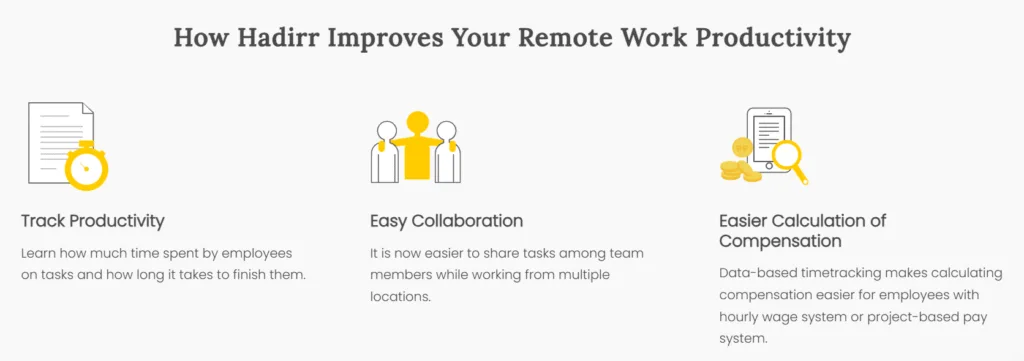
A mobile-first workforce platform built for Southeast Asian conditions should prioritize flexibility. Distributed teams need to log hours across projects, share tasks across locations, and ensure time is recorded transparently. For employees on hourly or project-based compensation, structured digital timesheets reduce ambiguity and align effort with pay.
When designed properly, a modern timesheet app does more than record hours. It generates traceable productivity patterns, helping managers understand task duration and identify bottlenecks—without resorting to intrusive surveillance.
Also read: AI in Performance Management: Beyond Annual Reviews
Attendance Validation in Hybrid and Field Environments

For many Indonesian businesses, particularly those with shift-based or mobile employees, attendance validation forms the operational backbone.
A robust attendance tracking app should provide real-time clock-in and clock-out records, supported by geofencing where necessary. Location validation confirms that employees are present at approved sites while avoiding monitoring beyond what is operationally justified.
Facial verification and remote clock-in capabilities are increasingly common in hybrid work settings. However, under Indonesia’s data protection framework, these features must be implemented proportionately and transparently. The objective is fraud prevention and administrative accuracy—not surveillance escalation.
When designed with regional realities in mind, attendance platforms must also account for varying device quality and inconsistent bandwidth. A system that fails under weak connectivity quickly becomes counterproductive.
Also read: Indonesia Labor Law: Key Rules for Foreign Business
Monitoring Client Visits and Field Activity

For sales-driven and service-oriented teams, time alone is not a sufficient indicator of productivity.
Field-focused systems increasingly combine GPS logs, visit timestamps, digital signatures, and structured meeting notes. This form of client visit tracking gives management visibility into engagement patterns—how often clients are visited, how long meetings last, and how territory coverage shifts over time.
Standardized reporting reduces manual recap work for HR and supervisors. Instead of chasing spreadsheets, leadership can analyze trends and intervene strategically when visit frequency declines or travel time increases.
The key, again, is balance. Location-based tracking must remain purpose-specific and proportionate to avoid breaching privacy expectations.
Also read: Work Permit Requirements to Employ Expatriates in Indonesia
The Critical Link: Turning Monitoring Data into Compliant Pay

Monitoring becomes operationally meaningful only when it connects directly to payroll.
Disconnected systems create disputes: unverified overtime, inconsistent wage calculations, delayed incentives, or mismatched tax deductions. These issues erode trust faster than the absence of monitoring itself.
An effective payroll engine in Indonesia must handle complex salary components—overtime rules, allowances, bonuses, BPJS social security contributions, and PPh 21 income tax deductions. When attendance and timesheet data flow automatically into payroll calculations, the risk of error drops significantly.
For foreign companies, this integration is not simply about efficiency. It is about compliance and legal defensibility. Accurate, auditable calculations protect against labour disputes and regulatory scrutiny.
This is where payroll integration software becomes central to the monitoring ecosystem rather than remaining a separate administrative tool.
Also read: Common Payroll Errors in Indonesia and How to Fix Them
Why Integration Matters More Than Individual Features

International CEOs and HR leaders often focus first on tracking capabilities. But sustainable workforce governance in Indonesia requires a broader perspective.
Structured workforce monitoring should provide visibility into how and where work happens. At the same time, it must respect privacy norms, align with PDPL requirements, and translate effort into transparent compensation.
When monitoring, attendance, client activity logs, and payroll operate within a connected framework, leadership gains more than control. They gain measurable insight into utilisation rates, labour cost allocation, overtime exposure, and productivity trends.
In short, the objective is not surveillance. It is alignment—between time, performance, compliance, and pay.
Also read: Employment Types in Indonesia: Contracts and Regulations
Hadirr & Gadjian: Integrated Productivity Monitoring Software for Indonesian Remote Teams

If you are scaling remote, hybrid, or field teams in Indonesia, generic global tools will not give you the control you think they will.
You need productivity monitoring software built for Indonesian infrastructure, aligned with local cultural dynamics, and fully compliant with data protection and labour regulations. And you need payroll systems that can automatically convert that verified activity data into accurate, defensible compensation.
Hadirr provides operational visibility without crossing into overreach.
Its timesheet capabilities show how long tasks actually take and how work moves across teams and locations—eliminating guesswork and end-of-month reconciliation shocks. Real-time attendance tracking, supported by geofencing and facial verification, replaces manual spreadsheets while maintaining proportionate, regulation-aligned monitoring.
For mobile and revenue-generating teams, GPS-verified client visit logs, meeting durations, and digital confirmations give managers immediate insight into field execution. Performance discussions shift from assumptions to evidence.
But monitoring alone does not create governance. Payroll closes the loop.
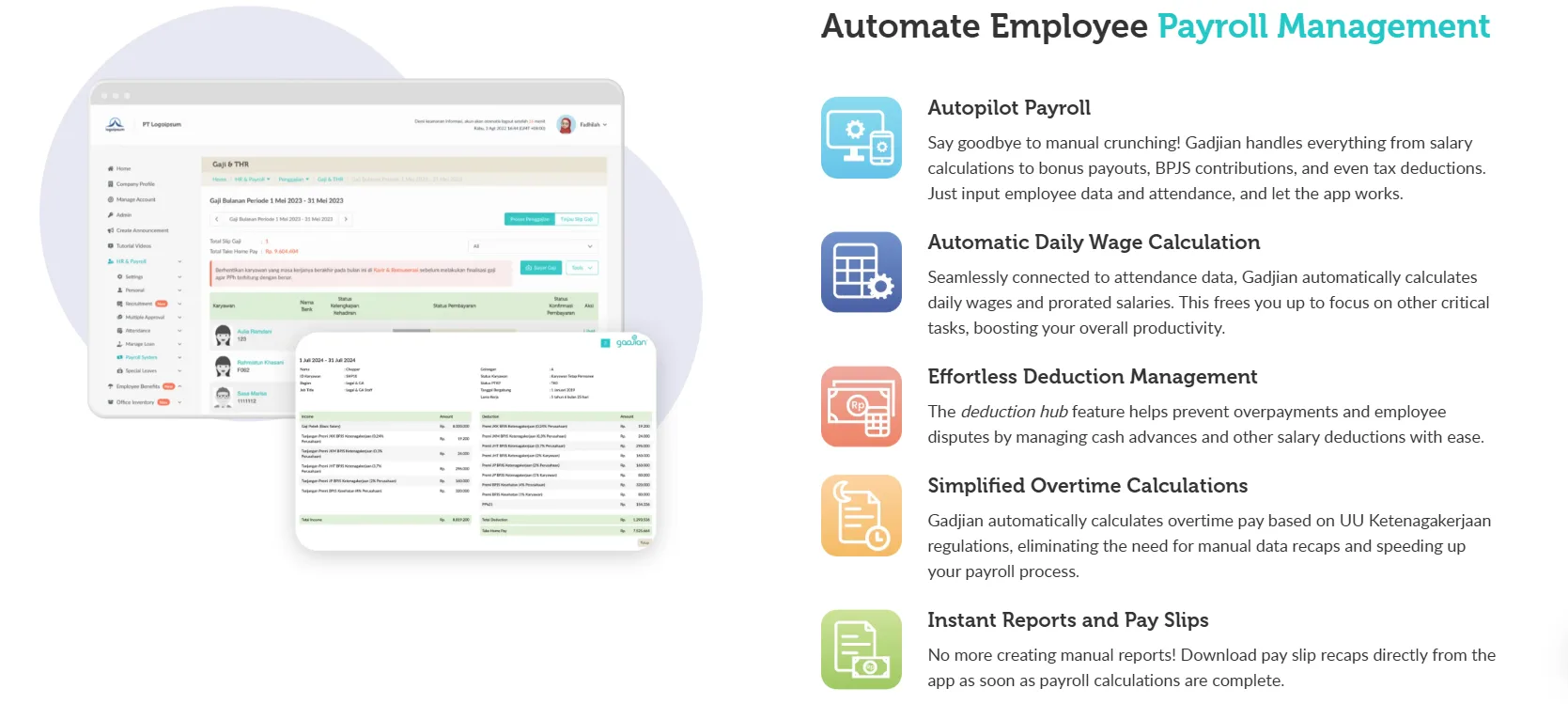
Gadjian transforms verified attendance and work-hour data into fully Indonesian-compliant salaries. Overtime, allowances, BPJS contributions, and PPh 21 deductions are calculated automatically. Payslips are generated instantly. Errors are prevented before they escalate into disputes.
Together, Hadirr and Gadjian create a single operational framework:
- Work is tracked
- Attendance is validated
- Field activity is documented
- Team collaboration is facilitated
- Compensation is calculated accurately and compliantly
For foreign CEOs, founders, and HR leaders, this is more than software adoption. It is risk reduction, cost control, and scalable workforce governance.
With integrated monitoring and payroll designed for Indonesian regulations, your expansion moves from experimental to operationally resilient.
Build your Indonesian workforce on data, compliance, and clarity—not assumptions.