

Foreign investors and business owners entering Indonesia face an early strategic choice: build an in-house HR team or outsource HR to a specialized provider. Understanding the pros and cons of HR outsourcing is critical in a market with complex labor regulations and strict compliance requirements.
This guide breaks down the key benefits and risks of HR outsourcing in Indonesia—helping you decide whether it fits your business model, growth pace, and operational priorities.
What Is HR Outsourcing?

HR outsourcing means delegating one or more HR functions—such as payroll, recruitment, benefits administration, compliance, or employee relations—to an external provider instead of managing them internally.
In Indonesia, HR outsourcing for foreign companies is often less about cost—and more about compliance and risk control.
Labor laws are highly protective, with strict rules on minimum wages, BPJS social security, PPh 21 income tax, leave entitlements, and termination procedures. Outsourcing HR can act as a risk buffer—reducing compliance exposure while allowing leadership to focus on scaling the business.
Globally, HR outsourcing is already mainstream. Around 57% of companies outsource at least one HR function, with reported average returns of 191% ROI. In Indonesia, adoption is accelerating as foreign investors increasingly rely on local HR experts to navigate regulatory complexity efficiently.
However, there are pros and cons of HR outsourcing that can significantly affect business decision-making. Let’s break down.
Also read: The Benefits of Using Payroll Outsourcing Services in Indonesia
Pros: Why Companies Choose HR Outsourcing

1. Predictable Costs Instead of Growing HR Overhead
For many foreign companies, HR costs creep up quietly. You start with one generalist, then realize you need payroll expertise, compliance support, and better systems. Salaries, tools, and training pile up fast.
Outsourcing HR flips this model. Instead of building permanent overhead, you pay a clear, service-based fee tied to your actual needs. For small to mid-sized teams, this often costs far less than hiring even one experienced HR manager—while still covering payroll, compliance, and reporting. The result isn’t just savings, but cost predictability when cash flow still matters.
2. More Focus on Growth, Less Time Lost to Administration
HR work is essential—but it rarely creates competitive advantage. Payroll runs, tax filings, leave approvals, and compliance tracking quietly drain management time every month.
When these functions are outsourced, founders and leaders regain focus. Time previously spent reviewing spreadsheets or chasing deadlines can go back into sales, market expansion, product decisions, and building the business itself. For startups and scale-ups, this shift in attention often matters more than any single efficiency gain.
3. Built-In Local Compliance Expertise
Indonesia’s labor regulations are detailed, local, and actively enforced. Minimum wages vary by region. BPJS and tax rules change. THR and overtime calculations leave little margin for error.
This is where HR outsourcing in Indonesia delivers real value. Reputable providers operate inside this regulatory environment every day. They track changes, apply rules consistently, and help companies avoid mistakes that trigger penalties or disputes. For foreign investors, one avoided compliance failure can easily justify months of outsourcing fees.
4. Easier Scaling as Headcount and Complexity Grow
HR rarely scales linearly. Going from 10 to 50 employees introduces new challenges: multiple job levels, different employment contracts, more payroll variables, and often multiple locations with different wage floors.
With HR outsourcing, growth doesn’t require building new internal infrastructure. Your provider absorbs the additional workload—onboarding, payroll processing, BPJS enrollment—without forcing you to hire more HR staff. This flexibility is especially valuable during rapid hiring phases or geographic expansion.
5. Fewer Errors in Payroll, Tax, and Benefits
Manual HR processes fail quietly. A wrong formula, an outdated tax rate, or a missed update can affect dozens of employees at once. For many companies, payroll and HR outsourcing delivers the highest return because errors in these areas carry immediate financial and legal consequences.
Outsourced HR providers rely on standardized systems and repeatable processes designed to reduce human error. Payroll, BPJS contributions, and tax calculations are handled through tested workflows rather than ad hoc spreadsheets. For companies operating under regulatory scrutiny, fewer errors mean fewer disputes—and fewer uncomfortable conversations with authorities.
6. Reduced Day-to-Day Administrative Noise
Payroll calculations, tax reporting, leave tracking, employee records—these tasks never disappear. When handled internally, they create a constant background load on HR and management.
Outsourcing consolidates this work into a single operational stream. One provider manages recurring processes, documentation, and reporting, while your internal team stays focused on people and strategy rather than paperwork. The benefit isn’t just efficiency—it’s mental bandwidth.
7. Faster, More Informed Recruitment
Hiring in Indonesia requires local market knowledge: realistic salary expectations, available talent pools, and cultural fit. Outsourced HR providers often maintain active recruitment networks and screening processes that outperform ad hoc hiring efforts.
Instead of starting from zero with each role, companies tap into existing pipelines—shortening hiring timelines and reducing the risk of poor-fit hires, especially in competitive or specialized roles.
8. Better Support for Distributed or Global Teams
As companies operate across time zones or adopt remote work, in-house HR availability becomes limited. Outsourcing partners often provide extended support hours, allowing employees to access payroll information, submit requests, or resolve issues outside local office hours.
This improves employee experience without increasing internal headcount—an often-overlooked advantage for international teams.
Also read: Job Posting Compliance for Hiring in Indonesia
Cons: Risks and Limitations to Consider

1. Less Direct Control Over Daily HR Decisions and Culture
Outsourcing HR inevitably creates distance. Even if you set the policies, execution happens outside your organization. Payroll timing, leave administration, recruitment screening, and onboarding workflows are handled by another team with their own processes and priorities.
For companies with strong founder-led cultures or non-standard ways of working, this can feel restrictive. External providers tend to favor standardization and risk avoidance, which may clash with highly customized compensation, fast hiring decisions, or informal people management styles. Over time, employees may also feel that HR decisions are coming from “outside,” weakening their sense of connection to leadership.
This doesn’t mean outsourcing kills culture—but it does mean culture needs to be actively protected.
2. Dependence on a Third Party for Critical Operations
Once HR is outsourced, your business becomes operationally dependent on your provider. If they miss a payroll deadline, miscalculate tax, or experience system downtime, the impact is immediate and very visible—employees feel it first.
The risk isn’t theoretical. Service quality can fluctuate as providers reassign staff, scale too quickly, or underestimate workload. Communication delays can slow urgent decisions, and in worst-case scenarios, providers may exit the market or be acquired, forcing an unplanned transition.
Outsourcing reduces internal workload, but it also concentrates operational risk. Choosing the wrong partner magnifies that risk rather than removing it.
3. Employee Data Leaves Your Direct Control
HR outsourcing requires sharing sensitive data: salary details, tax IDs, bank accounts, family information, and employment history. This data now lives in someone else’s system, managed by people you don’t supervise directly.
In an era of stricter data protection laws and rising cyber risk, this is a serious consideration. A breach doesn’t just trigger regulatory exposure—it damages employee trust, which is far harder to rebuild than compliance documentation.
Even without breaches, some companies are uncomfortable with external access to sensitive compensation or termination information, especially at senior levels.
4. Reduced Visibility Into What’s Really Happening
Outsourcing often replaces real-time visibility with periodic reports. You don’t see every payroll step, sit in interviews, or monitor approvals as they happen. Instead, you review outcomes after the fact.
This can delay problem detection. Errors, misalignment, or poor decisions may only surface weeks later—during reconciliation, employee complaints, or audits. There’s also a softer risk: external providers may not fully understand your business context, leading to decisions that are technically correct but culturally off.
Without deliberate communication routines, outsourcing can slowly disconnect leadership from the people’s side of the business.
5. Switching Providers Is Harder Than It Looks
HR outsourcing creates inertia. Once your data, processes, and documentation sit with one provider, moving becomes complex. Transitions require audits, data migration, parallel payroll runs, and careful coordination to avoid missed payments or compliance gaps.
Employees feel these transitions too—new systems, new contacts, and temporary confusion. Contracts may also include notice periods or limitations that slow exit.
The result is soft lock-in. Even if service quality declines, switching feels risky and time-consuming, which can keep companies stuck longer than they want.
6. Personal Attention May Decline as You Grow
Early in the relationship, outsourcing often feels very personal. But as your headcount grows, priorities can shift. Account managers change, teams rotate, and service becomes more standardized.
Unless the provider scales deliberately with you, your company may receive less attention just as your HR complexity increases. For fast-growing businesses, this mismatch can become frustrating—especially when responsiveness starts to slip.
Outsourcing works best when scalability is designed into the relationship.
7. Legal Responsibility Never Truly Transfers
One of the most underestimated HR outsourcing compliance risks is assuming that legal responsibility transfers fully to the provider—which it does not.
If PPh 21 is miscalculated or BPJS payments are late, regulators hold your company accountable—not your outsourcing partner. Outsourcing shifts execution, not liability. Without internal oversight, companies can be exposed without realizing it until penalties arrive.
Outsourcing reduces operational burden, but governance responsibility remains firmly in-house.
8. Slower Development of Internal HR Capability
Outsourcing HR also means outsourcing learning. Your team doesn’t develop deep payroll knowledge, regulatory expertise, or institutional HR memory. Over time, this can limit strategic flexibility.
If you later decide to bring HR in-house, you may find yourself rebuilding from zero—without experienced internal talent or documented know-how. For companies planning long-term operations in Indonesia, this trade-off deserves careful thought.
Also read: Indonesia Labor Law: Key Rules for Foreign Business
Pros and Cons of HR Outsourcing by Company Size

So where do the pros and cons of HR outsourcing matter most?
HR outsourcing works best at certain stages. What’s efficient for a 20-person startup can become inefficient for a 500-person organization. The real strategic question isn’t whether to outsource HR, but when to outsource HR as your organization grows.
1. Micro and Small Businesses (Under 50 Employees)
For very small teams, HR outsourcing usually makes the strongest case. Most companies at this stage don’t have dedicated HR staff, yet payroll, tax, BPJS, and leave compliance are already complex. Outsourcing fills this gap at a lower cost than hiring even a junior HR role, while providing immediate access to systems and regulatory expertise.
The key risk here is provider quality. Smaller teams depend heavily on their outsourcing partner, so reliability and data security matter more than contract sophistication.
2. Medium Enterprises (50–500 Employees)
At this stage, the debate shifts from outsourcing versus cost, to HR outsourcing vs in-house HR as a strategic capability decision. Complexity increases—larger payroll runs, multiple UMK rates, higher recruitment volume, and greater compliance exposure. Outsourcing can still reduce cost and risk, especially for fast-growing companies or those new to Indonesia.
Many companies in this range adopt a hybrid approach: outsourcing payroll, tax, and BPJS while keeping recruitment and people management in-house. Full outsourcing is less suitable if internal HR leadership is already strong or if HR practices are highly customized.
3. Large Companies (500+ Employees)
For large organizations, full HR outsourcing is generally less compelling. Economies of scale make in-house HR more cost-effective, and direct control over culture, policy, and employee relations becomes critical.
Outsourcing at this stage is usually selective—focused on specialized areas such as payroll processing, expatriate administration, or regional operations where local expertise is needed. Here, outsourcing supports internal capability rather than replacing it.
Also read: Recruitment of Foreign Workers Regulation Indonesia: A Complete Guide
Decision Framework: Should You Outsource HR in Indonesia?

Don’t be confused by the pros and cons of HR outsourcing—there’s no universally “right” answer. The right decision depends on where your company is today—and where you plan to be in the next 12–24 months. Use this framework to pressure-test your situation honestly.
This HR outsourcing decision framework helps you evaluate cost, control, compliance, and scalability trade-offs.
1. When Outsourcing HR Makes Sense
Outsourcing is usually the right move if HR complexity is already outpacing your internal capacity.
This is especially true if you’re a foreign investor new to Indonesia. Local labor rules around payroll, tax (PPh 21), BPJS, leave, THR, and termination are technical and unforgiving. If your team doesn’t have hands-on experience navigating them, outsourcing functions like payroll and compliance becomes a form of risk insurance.
Outsourcing also works well when your headcount sits roughly between 10 and 150 employees. At this stage, hiring a full HR team is expensive, yet HR mistakes are costly enough to hurt. Outsourcing lets you convert fixed HR costs into flexible operating expenses while accessing expertise you don’t yet have in-house.
It’s also a strong option if your leadership team wants to stay focused on growth—sales, product, expansion—rather than spending cycles on monthly payroll runs, BPJS filings, or tax reconciliations. You give up some day-to-day control, but gain speed, predictability, and compliance confidence.
2. When Keeping HR In-House Is the Better Choice
Outsourcing becomes less attractive when HR is no longer just operational—but strategic.
If you have 500+ employees, dedicated HR leadership, and mature internal systems, in-house HR often delivers better control and long-term value. At this scale, you can justify specialized roles and internal governance that outsourcing can’t fully replicate.
Companies with highly customized people practices also tend to struggle with full outsourcing. If your culture relies on founder-led decision-making, unconventional compensation structures, or deeply personalized employee experiences, standard outsourcing models may feel restrictive.
The same applies if you’re planning long-term operations in Indonesia and want to deliberately build internal HR capability. Outsourcing everything for years can leave you dependent on vendors and without institutional knowledge when you eventually want to bring HR back inside.
3. The Hybrid Model: Where Most Growing Companies Land
For many companies, the smartest answer isn’t “outsource” or “don’t outsource”—it’s where to outsource. HR outsourcing for growing companies works best when flexibility and speed matter more than full internal control.
A hybrid approach keeps strategic, culture-critical functions in-house while outsourcing technical, compliance-heavy work. Payroll processing, PPh 21 tax calculation, and BPJS contributions are high-stakes and rules-driven. These are areas where mistakes are expensive and expertise matters more than customization.
Meanwhile, recruitment, employee relations, performance management, and culture-building often belong inside the company. These functions benefit from proximity to leadership, deep context, and daily interaction with employees.
This split gives you the best of both worlds: operational reliability where errors hurt most, and direct control where people and culture matter most.
Also read: A Startup’s Guide to Payroll Outsourcing in Indonesia
Pegawe: Indonesia’s Best HR Outsourcing Services for Your Business

Beyond the pros and cons of HR outsourcing, if you require to fully outsource your HR tasks or build a hybrid HR system, Pegawe is ready to help you.
Pegawe is an HR outsourcing provider focused on supporting foreign-owned companies operating in Indonesia. Its services are structured modularly, allowing companies to outsource specific HR functions without committing to full HR delegation.
Core Services Provided by Pegawe
1. Payroll and Compensation Management
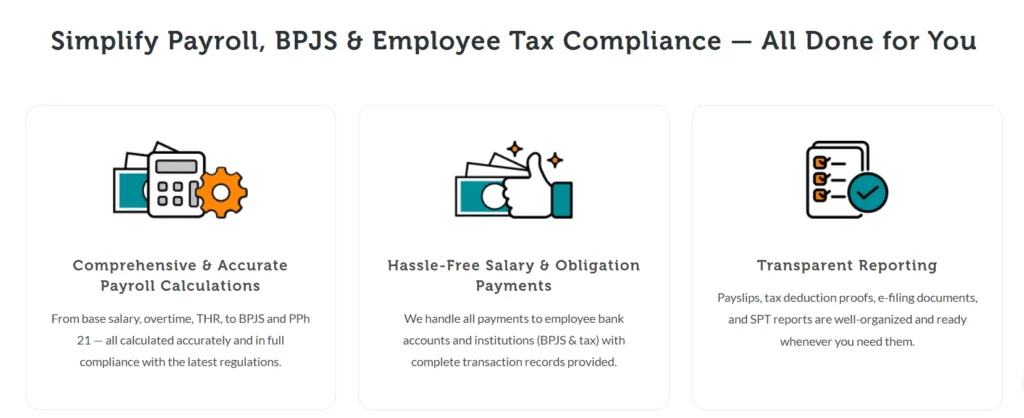
Pegawe manages end-to-end payroll processing, including salary calculation, deductions, bonuses, THR, overtime, and other compensation components based on recorded working hours. Clients submit monthly employee data and changes, and payroll is processed with salaries disbursed directly to employee bank accounts.
2. PPh 21 and PPh 26 Tax Administration
Pegawe calculates and administers income tax obligations, including PPh 21 for local employees and PPh 26 for expatriate-related payments. Services include monthly withholding, reporting, year-end tax documentation, corrections, and provision of compliant, ready-to-file outputs.
3. BPJS Kesehatan and BPJS Ketenagakerjaan Management
Pegawe handles employee registration, contribution calculations, monthly payments, salary change reporting, and BPJS-related administration. This centralizes social security compliance and payment management within one service provider.
4. Recruitment and Talent Sourcing
Pegawe supports recruitment through candidate sourcing, screening, interview coordination, and onboarding assistance. Clients receive shortlisted candidates for final selection, reducing internal workload during hiring cycles.
5. Employee Off-Record (EOR) Services
For companies requiring flexible workforce arrangements, Pegawe offers EOR services where Pegawe acts as the legal employer. This includes compliance management, payroll, and administration for outsourced teams such as sales or customer support.
Why Pegawe Is Relevant for Foreign-Owned Companies
- Indonesia-specific compliance coverage
Services are structured around Indonesian labor law, tax regulations, BPJS requirements, and outsourcing frameworks, with processes updated to reflect regulatory changes. - Integrated HR administration
Payroll, tax, BPJS, and recruitment services are managed under a single provider, reducing coordination across multiple vendors. - Scalable service structure
Clients can start with limited services (e.g., payroll and tax) and expand scope as headcount and operational needs grow. - Dedicated account management
Each client is supported by an assigned account team responsible for coordination, reporting, and ongoing operational support. - Local operational presence
Pegawe operates locally in Indonesia, including payroll disbursement, BPJS liaison, and compliance administration, with employee data handled within Indonesia’s regulatory framework.

Or, Manage HR In‑House with Gadjian
If you decide to build your own HR team instead of outsourcing, make it efficient with Gadjian—Indonesia’s leading web‑based payroll software. Gadjian helps you automate employee administration and salary processing, calculate PPh 21, BPJS, bonuses, overtime, and leave—all in one dashboard.
No matter the pros and cons of HR outsourcing, Pegawe and Gadjian make scaling your business simpler and more efficient. Save hours every month, reduce manual errors, and keep your HR operations lean, smart, and compliant.