
AI workplace management is becoming a priority for modern offices in Indonesia—as hybrid work becomes standard, operating costs rise, and competition for skilled talent intensifies. Yet many organizations still lack visibility into what truly drives productivity or quietly holds it back. Fragmented HR data, inefficient space usage, manual security, rising energy costs, and invisible disengagement remain common, often surfacing only when employees resign.
This is the old workplace reality—and it steadily erodes competitiveness.
AI workplace management addresses this gap by combining intelligent automation and real-time analytics to improve how attendance, space, staffing, and engagement are managed, while linking workforce decisions more closely to business outcomes.
For foreign investors and business leaders expanding into Indonesia, AI workplace management has become a baseline expectation. Companies that adopt smart office ecosystems attract talent faster, retain employees longer, and operate more efficiently than those still relying on spreadsheets and intuition.
The Workplace Inefficiencies Most Companies Don’t See

Let’s start with the numbers. According to a global survey, nearly all respondents (91%) report using generative AI in their work, with the vast majority expressing optimism about its impact. Most believe gen AI will improve their work experience and support a wide range of skills, from critical thinking to creativity.
Yet inside many organizations, this adoption remains fragmented. Employees use gen AI for writing or research, while scheduling, attendance tracking, and performance management still rely on standalone tools and spreadsheets—leaving most workplace data disconnected.
What’s missing is not AI adoption itself, but the ability to connect and interpret data across systems. Without this coordination, critical patterns and warning signs often go unnoticed.
Hidden Inefficiencies in the Workplace
Space is wasted. You lease 500 square meters of office space for 60 employees, yet on most days only 40% of desks are actually used. Meeting rooms stay booked even when no meetings take place. The unused space still consumes energy—driving up electricity bills without delivering productivity value.
Time is squandered. Administrative tasks such as scheduling meetings, processing timesheets, approving leave, and compiling attendance reports consume an estimated 8+ hours per employee every week—roughly 20% of working time lost to overhead.
Engagement is invisible. Disengagement often goes unnoticed until an employee resigns. There is no early-warning signal, no clear view of which teams are struggling, and no reliable way to see where attrition risk is building.
Decisions lack data. Staffing adjustments, budget allocation, and office expansion are often based on assumptions rather than clear insight into how time and space are actually used.
Security is fragmented. Access control remains manual. CCTV operates separately from attendance systems. There is no consistent view of who is in the building, when they arrived, or which areas they accessed.
AI workplace management changes this dynamic. By aligning attendance, space usage, performance, security, energy, and engagement data, organizations move from reactive problem-solving to proactive, data-driven management.
Also read: Recruitment of Foreign Workers Regulation Indonesia: A Complete Guide
What AI Workplace Management Really Means in Practice

AI workplace management refers to using artificial intelligence and real-time analytics to improve how people work, where they work, and how outcomes are measured.
In practice, smart office ecosystems bring several workplace functions under a shared intelligence layer:
Attendance and Workforce Analytics
Real-time tracking captures when employees arrive and leave, how time is distributed between meetings and focused work, and patterns that signal broader productivity trends. AI highlights anomalies—sudden shifts that may indicate disengagement, burnout, or flight risk.
Space Optimization
IoT sensors monitor actual use of desks, meeting rooms, and shared areas. Usage data helps organizations right-size their office footprint. When only 40% of a 500-square-meter office is consistently used, the financial impact becomes visible and quantifiable.
Performance and Productivity Insights
Instead of relying on annual reviews, AI-powered analytics track output, collaboration patterns, project progress, and goal attainment continuously. High performers, struggling employees, and under-supported teams become visible in real time.
Predictive Workforce Planning
AI forecasts staffing needs by combining historical demand, project timelines, skill profiles, availability, and turnover patterns. This allows organizations to anticipate gaps and adjust schedules before bottlenecks appear.
Access Control and Security
Biometric or RFID-based access systems log workplace entry and movement, creating a reliable audit trail. AI flags unusual access behavior, while cloud-connected CCTV provides verification where needed.
Energy Management
Smart building systems adjust lighting, temperature, and HVAC based on occupancy and time of day. Energy dashboards highlight inefficiencies and cost-saving opportunities without manual monitoring.
Employee Engagement Signals
Engagement is assessed through multiple indicators—meeting participation, project involvement, collaboration patterns, and responsiveness. Concerning trends surface early, long before they lead to resignations.
These functions reinforce one another. Space usage informs workforce planning. Attendance patterns support productivity analysis. Engagement signals help predict retention risk. Together, they form a smart office ecosystem where decisions are based on evidence rather than intuition.
Also read: Job Posting Compliance for Hiring in Indonesia
Why AI Workplace Management Now Shapes Competitive Advantage
The business case is increasingly clear.
Productivity gains are substantial. A 2022 McKinsey study found that organizations adopting automation achieved average efficiency improvements of 20–30%. Separately, PwC reports that companies integrating AI across their operations could see productivity gains of up to 40% over the next decade. For a team of 50 employees, even a 30% lift in productivity is effectively equivalent to adding 7.5 full-time roles—without increasing headcount.
Administrative burden drops sharply. Automation eliminates 3.5+ hours of administrative work per employee each week. In a 100-person company, that equals roughly 350 hours recovered weekly.
Time savings are measurable. Federal Reserve research shows AI-integrated systems save 5.4% of weekly working hours—about 115 hours per employee annually.
Engagement improves. Smart office environments increase job satisfaction by up to 30%, reduce stress from manual processes, and strengthen collaboration—factors closely tied to retention and performance.
Market growth reflects momentum. The global smart office market will grow from $60.36 billion in 2025 to $102.23 billion by 2029, expanding at an annual rate of 14.1%
ROI is compelling. For every dollar invested in AI workplace management, companies report approximately $3.70 in productivity gains and cost savings, often recovering investment within six to nine months.
Adoption is accelerating. Seventy-eight percent of organizations now use AI in at least one business function. In competitive industries, delayed adoption increasingly translates into operational disadvantage.
Also read: Indonesia Labor Law: Key Rules for Foreign Business
Why This Matters Specifically in Indonesia

Indonesia’s business environment adds urgency.
Talent competition is intense. With more than 2,500 startups and 500+ multinational offices, skilled professionals have options. Companies offering modern, data-enabled workplaces attract stronger candidates faster.
Regulatory compliance is complex. Indonesian labor laws impose detailed requirements on hours, overtime, leave, and compensation. AI workplace management systems built for local regulations reduce compliance risk by design.
Space costs continue to rise. Jakarta office rents have increased roughly 40% over five years. Optimizing space usage can reduce real estate costs by 15–25%, often the second-largest expense after payroll.
Hybrid work is now standard. Managing attendance, desk-sharing, and cross-team coordination at scale requires systems that manual spreadsheets cannot support.
Digitalization is a competitive advantage. Early adopters of smart office technology position themselves as efficient, credible employers—an advantage with investors, partners, and talent.
Jakarta itself is setting the benchmark. New developments increasingly include smart office automation as a baseline, raising expectations across the market.
Also read: Income Tax in Indonesia for Foreign Businesses
Inside AI Workplace Management: The Five Systems Powering Smart Offices

AI workplace management operates as a coordinated system, where data from everyday workplace activity is translated into actionable insight.
1. Real-Time Attendance and Productivity Tracking
Beyond clock-in data, AI captures arrival patterns, meeting load, collaboration intensity, and task allocation. Over time, it reveals productivity rhythms that are easy to miss—such as consistent performance drops after certain hours—allowing leaders to adjust schedules and lift output without adding headcount.
2. Space Optimization and Utilization
Usage data from desks and meeting rooms shows which spaces deliver value and which quietly drain resources. When only 400 of 1,000 square meters are consistently used, decisions shift from debate to evidence.
3. AI-Powered Performance and Commitment Analytics
Continuous analysis replaces annual reviews. Goal progress, collaboration quality, and commitment indicators create a live view of workforce health, making disengagement visible long before resignation.
4. Predictive Workforce Scheduling and Planning
By combining demand patterns, skill data, availability, and turnover trends, AI improves scheduling accuracy and reduces both understaffing and overstaffing.
5. Integrated Security and Access Control
Access logs, dashboards, and verification tools improve visibility and compliance while feeding accurate attendance and utilization data into broader analysis.
Together, these systems support informed decision-making across people, space, and cost.
Also read: Work Permit Requirements to Employ Expatriates in Indonesia
Building Your AI Workplace Management Strategy: A Practical Roadmap

Implementing AI workplace management does not need to be disruptive. A phased approach allows organizations to move from fragmented systems to a functioning smart office ecosystem within months.
Phase 1: Define Your Current State
The process begins by establishing a clear baseline. Organizations should assess how the workplace operates today, including how much office space employees actually use, how much time they spend on administrative tasks, and where the biggest people-related challenges lie
High turnover, low engagement, or persistent skill gaps often signal deeper visibility issues. This phase also clarifies which decisions would benefit most from better data and sets realistic boundaries around budget and technology investment.
Phase 2: Identify High-Impact Opportunities
With baseline data in place, leadership can prioritize where AI workplace management will deliver the fastest and most measurable returns. For some organizations, space optimization surfaces immediate cost savings.
Others see greater impact from reducing administrative overhead, improving retention, or lifting productivity. These priorities are translated into clear success metrics that later anchor ROI measurement.
Phase 3: Select and Implement the Right Platform
Execution follows prioritization. Organizations should choose a platform aligned with their goals and operating environment. For HR-driven use cases, solutions such as Gadjian provide integrated attendance, performance, and engagement analytics tailored to Indonesian labor regulations.
For space utilization and security, many companies adopt systems already proven in Jakarta’s smart office developments. At this stage, integration capability, real-time analytics, regulatory compliance, scalability, and mobile accessibility are critical.
Phase 4: Activate Data and AI Analysis
After deployment, value creation begins with data activation. Attendance, performance, space, security, and engagement data are connected into a single ecosystem, enabling AI analytics to process both historical and real-time inputs. Automated reporting is established, and managers are trained to use dashboards as active decision tools rather than static reports.
Phase 5: Act on Insights and Measure Results
The final phase is continuous. As insights flow, organizations move from observation to action. Monthly reviews focus on attendance trends, engagement signals, and flight-risk indicators to enable early intervention.
Quarterly analysis examines space utilization, productivity, and workload distribution to guide structural adjustments. Annually, leaders assess progress against success metrics, calculating ROI through productivity gains, real estate savings, retention improvements, and recovered administrative time.
When executed well, this roadmap turns AI workplace management from a technology initiative into a compounding operating advantage—one that strengthens as data quality and organizational maturity grow.
Also read: Employment Types in Indonesia: Contracts and Regulations
How Gadjian’s HR Analytics Dashboard Supports AI Workplace Management
For organizations operating in Indonesia, the challenge is not ambition but practicality. Gadjian’s HR Analytics Dashboard is designed to support data-driven workforce management within local regulations and real operational constraints.
Rather than introducing standalone tools, Gadjian embeds analytics into daily HR workflows, enabling companies to extract insight from data they already generate.
Here are what Gadjian’s AI Analytics delivers:
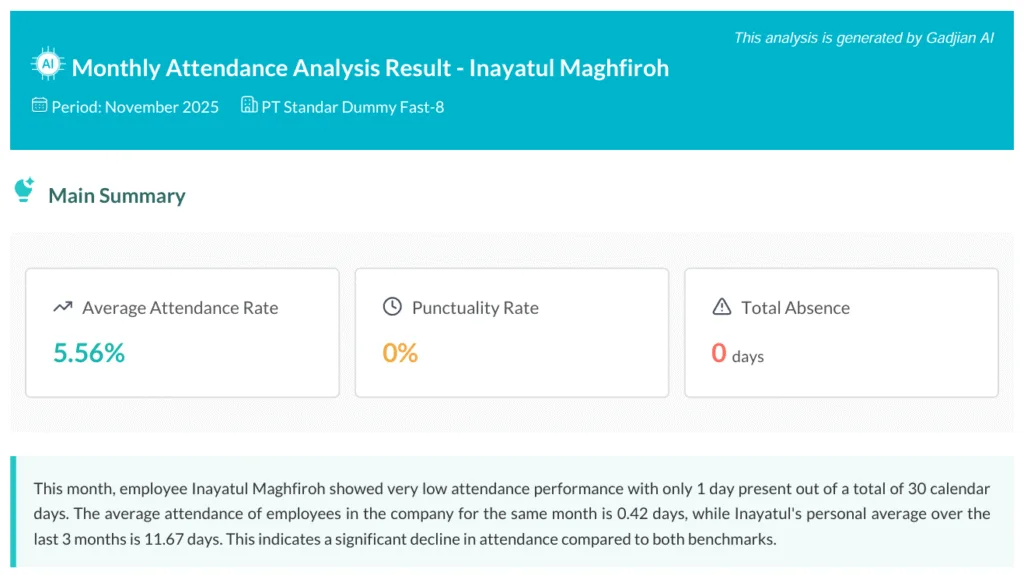
AI Analytics for Attendance, Leave, and Employee Commitment
Gadjian’s AI Analytics analyzes attendance, leave, sick days, and vacation patterns to detect meaningful shifts in employee behavior over time. Instead of relying on manual timesheet reviews, managers gain early visibility into potential engagement or retention risks as patterns begin to change.
Key capabilities include:
- Monthly and year-to-date views of attendance and absence trends
- Text-based insights supported by visual charts highlighting anomalies
- Early indicators of declining commitment or irregular behavior
- Exportable PDF reports suitable for internal reviews and leadership discussions
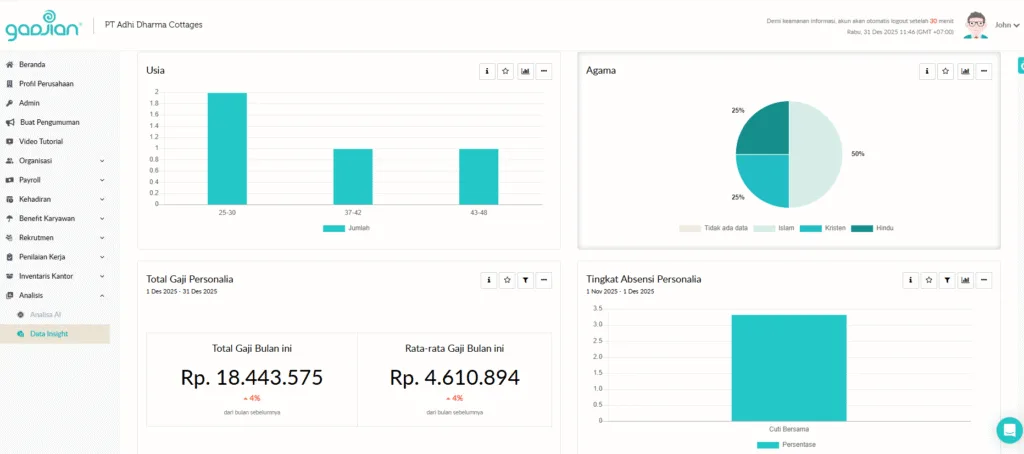
Data Insights: Real-Time Organizational Intelligence
Gadjian’s Data Insights feature provides a consolidated, real-time view of organizational data without requiring manual processing or spreadsheet reconciliation.
This includes visibility into:
- Employee demographics such as age, tenure, role distribution, and location
- Salary and compensation structures, including equity and consistency analysis
- Productivity metrics related to output, project completion, and efficiency
- Engagement indicators reflecting collaboration, communication, and satisfaction
These insights are delivered through clear visualizations that help leadership teams move from observation to informed decision-making.
Performance Management and Continuous Feedback
Instead of relying on static quarterly reviews, Gadjian enables continuous performance management supported by real-time data and structured feedback. Managers gain clearer visibility into employee contributions while employees understand expectations and progress throughout the review cycle.
Key capabilities include:
- Goal setting and tracking aligned with individual, team, and company objectives
- Ongoing performance reviews supported by measurable activity and attendance data
- Structured performance notes and feedback to support fair, evidence-based evaluations
- Clear documentation to support promotions, development plans, and performance improvement decisions
All performance data is centralized, easy to review, and designed to support consistent evaluations—making it suitable for both routine leadership check-ins and formal performance discussions.
Minimum Deployment and Seamless Integration
Gadjian’s HR Analytics Dashboard is available for organizations with a minimum of 15 employees on subscription. The analytics layer integrates seamlessly with existing Gadjian modules—automated payroll, leave management, and performance (KPIs) tracking—creating a unified data foundation without introducing additional systems.
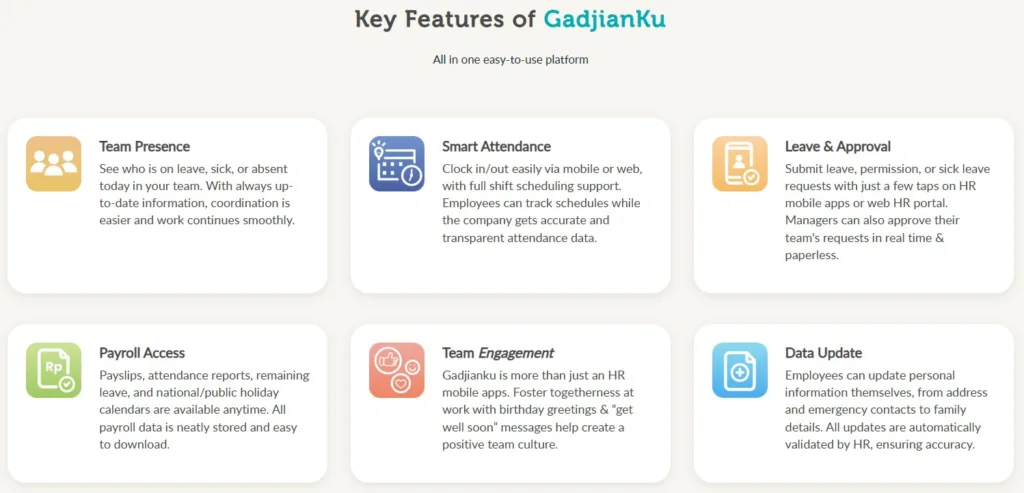
Everything HR needs is in Gadjian with Attendance Management System
To complement Gadjian’s analytics, Gadjian has released a new feature that provides digital attendance tracking and daily productivity monitoring. It captures employee hours automatically, generates actionable real-time insights on time utilization, and integrates directly into the smart office ecosystem. As a result, Gadjian provides a complete, real-time view of workforce activity, enabling better staffing decisions, proactive engagement management, and improved operational efficiency. Everything HR needs is in Gadjian.
For foreign investors and business leaders expanding into Indonesia, AI workplace management increasingly defines how effectively organizations scale, retain talent, and stay compliant. Companies that build visibility early tend to make better decisions later—about people, space, and cost structures.
The real question is no longer whether AI workplace management matters, but how quickly organizations can begin learning from their own data. Gadjian provides one practical path to start that process—grounded in local context, integrated workflows, and real operational use cases.