
You’re managing a growing team in Indonesia when it starts to happen. First, your best engineer gives notice. Then your top sales manager resigns. Soon after, your product lead follows. By the time the pattern becomes clear, momentum is gone, morale is shaky, and recruitment costs are spiraling—the exact scenario an AI employee retention strategy is meant to address.
What if you could have seen these exits coming months earlier?
Modern AI-driven retention approaches use predictive analytics and machine learning to flag employees who are at risk of leaving—often months before a resignation email ever lands in your inbox. Used effectively, this creates a competitive advantage that protects your bottom line, stabilizes teams, and supports long-term growth.
In this guide, we’ll break down how AI employee retention strategy systems actually work, why they matter for companies operating in Indonesia, and how you can adopt them using tools like Gadjian’s advanced HR analytics platform—without overcomplicating your HR operations.
Why You’re Losing Good People

As hiring costs rise and replacement cycles slow down, retention has quietly become the fastest lever for protecting growth in Indonesia’s increasingly talent-constrained market.
The local labor market is brutally competitive. Skilled engineers, marketers, product managers, and operations professionals have options—and they’re actively exploring them. Industry surveys and insights from Indonesian startup leaders suggest that over 65% of startups struggle to retain key talent, even when they offer competitive salaries and equity.
And here’s the catch: the problem isn’t always money. High performers leave because they feel undervalued and underappreciated. They are stuck without a clear career path, burned out by excessive workloads, disconnected from the company’s mission, overlooked for promotions, and left under-trained or under-developed.
Unfortunately, traditional HR approaches detect these signals far too late. Exit interviews happen after the decision is made. Annual performance reviews come once a year. Casual check-ins depend heavily on managers noticing the right things. By the time dissatisfaction becomes visible, your best people are already talking to competitors.
AI-driven retention strategy flips this model entirely. Instead of waiting for warning signs, companies actively monitor engagement patterns, identify burnout risks early, and intervene with targeted retention actions. The result is tangible: organizations using AI-powered employee retention analytics have reduced turnover by up to 30%—a measurable impact on stability, productivity, and growth.
Also read: Recruitment of Foreign Workers Regulation Indonesia: A Complete Guide
What Is an AI Employee Retention Strategy and How Does It Work?

An AI employee retention strategy combines three core technologies: predictive analytics, machine learning, and real-time engagement monitoring. Together, they help companies move from reactive HR decisions to proactive retention planning.
Here’s how the system works in practice.
Predictive Analytics: Spotting Flight Risks Before They Leave
Predictive turnover analytics examines your historical employee data—tenure, salary history, performance ratings, engagement scores, attendance patterns, promotion history, and skill development—to build a model that explains who stays and who leaves.
Once trained, the model scores your current workforce. It might flag one employee with an 85% likelihood of staying, while identifying another with a 60% chance of leaving within the next six months. It’s not perfect—but it’s powerful.
Among various approaches, Random Forest—one of the most widely used machine learning algorithms in turnover prediction—has emerged as one of the most effective techniques, delivering high predictive accuracy across multiple studies.
The model evaluates variables that matter, including job satisfaction scores from surveys, performance and promotion history, compensation relative to peers and market benchmarks, tenure and age, work hours and workload, department and role, training hours and skill development, and demographic indicators, where legally and ethically appropriate.
When analyzed together, these signals reveal patterns humans often miss. For example, the model may detect that employees with zero training hours in the past year leave 3x faster than those receiving regular development. Or that turnover in marketing runs 40% higher than engineering due to differences in management style.
Machine Learning: Continuous Improvement Over Time
Unlike static HR reports, machine learning models evolve. As new data flows in—resignations, promotions, engagement scores—the system recalibrates itself. Predictions become sharper, risk signals more precise, and insights more actionable.
This creates a self-reinforcing loop: better predictions lead to better interventions, which produce better outcomes—and, in turn, even more accurate future predictions.
Real-Time Monitoring: An Early Warning System
Instead of waiting for quarterly reviews, AI-based retention systems monitor engagement continuously. Dashboards surface insights such as employees whose engagement scores dropped sharply in the past month, teams showing consistently low morale or rising burnout indicators, departments with recurring or seasonal turnover patterns, and individuals whose work behavior has shifted—shorter hours, fewer meetings, reduced productivity.
Real-time monitoring turns retention into an early warning system. You identify issues weeks before a resignation happens, giving leaders time to intervene—while retention is still possible.
Importantly, effective AI retention systems focus on behavioral patterns, not surveillance—using aggregated, ethically governed data to support employees, not penalize them.
Also read: Job Posting Compliance for Hiring in Indonesia
Why AI-Driven Employee Retention Strategy Works Better Than Traditional Approaches

Traditional HR relies heavily on reactive signals. Annual performance reviews are too infrequent to surface real problems. Exit interviews are already too late when the decision is made.
Manager “gut feel” is subjective, biased, and inconsistent. Engagement surveys are often annual—with delayed insights. While turnover metrics tracked in spreadsheets are backward-looking, not predictive.
An AI-driven employee retention strategy works differently. It’s proactive, data-driven, and continuous by design.
The Data Advantage
AI can process massive volumes of employee data simultaneously—something even the most experienced HR teams can’t do manually. A company with 500 employees may generate thousands of data points per person: attendance records, salary history, performance reviews, survey responses, training participation, project assignments, even work activity patterns.
No HR manager can synthesize all of this into reliable retention insights. AI can—within seconds.
The Pattern Recognition Advantage
Human managers see individuals. “Sarah looks engaged, or Tom seems bored.” But AI sees organizational patterns. It identifies signals like:
- Employees in specific roles under specific managers experiencing 40% higher turnover
- Workers who participate in skill-development programs leaving 25% less frequently
- Staff with no promotion conversation in 18 months leaving 2x faster
These insights power targeted, strategic interventions—ones that actually change outcomes, not just symptoms.
The Real-Time Advantage
AI systems don’t wait for quarterly reviews or annual reports. They surface flight risks as they emerge, allowing leaders to act now—not three months later, when the resignation is already drafted.
This is where machine learning turnover prediction delivers its biggest edge: speed.
The Cost Advantage
Replacing a skilled employee costs 50–200% of their annual salary, factoring in recruitment, onboarding, lost productivity, and team disruption. Retaining just one high-risk engineer or manager often offsets the entire investment in AI-powered retention analytics.
In short, prevention is dramatically cheaper than replacement—and AI makes prevention possible at scale.
Also read: Indonesia Labor Law: Key Rules for Foreign Business
How Companies Are Using AI for Employee Retention
Leading organizations are already using AI-powered retention strategies—and seeing measurable results.
- IBM used Watson AI to predict flight-risk employees with up to 95% accuracy, focusing on high performers with in-demand skills. Targeted interventions helped reduce turnover in key divisions by 30–35%, saving nearly $300 million in hiring and training costs.
- Microsoft leveraged real-time engagement analytics through Workplace Analytics and Viva Insights to detect disengagement early. By intervening before employees reached the resignation stage, the company achieved a 25% reduction in turnover.
- Salesforce applied predictive analytics and machine-learning models to identify attrition patterns and launch targeted engagement programs. This data-driven approach led to a 15% decrease in overall turnover.
- Airbnb analyzed AI-powered exit interviews using natural language processing to uncover preventable attrition drivers. Addressing these insights resulted in a 15% reduction in turnover and broader cultural improvements.
These outcomes aren’t the result of luck or generous perks. Each company followed the same playbook: identify flight-risk employees early, understand the drivers behind their disengagement, and intervene with targeted actions at the right moment.
This is where AI-driven employee retention benefits become tangible. AI makes it possible to run retention strategies at scale—consistently, systematically, and with far greater precision than traditional HR methods.
Also read: Work Permit Requirements to Employ Expatriates in Indonesia
Building Your AI Employee Retention Strategy

You don’t need a team of data scientists to build an effective AI employee retention strategy. What you need is structure, clarity, and a willingness to treat retention as a system—not a series of one-off fixes. In practice, most companies roll this out in phases.
1. Audit Your Current Reality
Before AI can help you predict anything, you need a clear baseline. This phase isn’t about technology—it’s about understanding where you actually stand today.
Start with the fundamentals: your annual turnover rate, the split between voluntary and involuntary exits, and which departments lose people fastest. Look at average tenure by role, and estimate how much turnover is costing you—using 1–2x annual salary as a rough benchmark. Most importantly, identify which departures hurt the most: key roles, high performers, or recently trained employees.
This baseline matters. Without it, you won’t know whether your AI-driven retention efforts are working—or just generating dashboards.
2. Identify What’s Really Driving Turnover
Every company loses people for different reasons. AI doesn’t guess those reasons—it learns from data you already have.
Work with your leadership and HR teams to map out the most likely drivers of attrition in your organization. These often include compensation competitiveness, career development opportunities, manager quality, workload, cultural alignment, flexibility, team dynamics, and access to training.
Then, ground those assumptions in data. Review exit interview responses. Survey current employees on engagement and satisfaction. Analyze promotion patterns, compensation gaps, workload distribution, and training participation. This is the raw material your AI model will use to detect risk patterns—so the quality of input here matters.
3. Implement AI Analytics
Once your data foundation is clear, it’s time to introduce AI-powered analytics.
At this stage, companies typically deploy an HR analytics platform with retention detection capabilities. The platform analyzes historical and real-time data to surface early warning signs—without requiring manual data processing. Leaders get visual dashboards for demographics, compensation, and productivity, while predictive alerts flag employees who may be at risk of leaving.
From here, the system begins scoring employees by flight risk. This is where intuition gives way to evidence.
4. Turn Insights Into Intervention Playbooks
Insights alone don’t retain anyone—actions do.
Effective companies design specific intervention playbooks for different risk profiles. A disengaged top performer may need a clear development path, expanded responsibility, or senior mentorship. A burned-out employee might need workload rebalancing, project changes, or flexible arrangements. Someone who’s undercompensated may require a market adjustment, bonus, or benefits review. Employees who feel disconnected often respond best to direct leadership engagement or cross-functional opportunities.
The key is personalization. Someone leaving due to stalled growth needs a very different response from someone overwhelmed by workload or misaligned compensation.
5. Monitor, Learn, and Iterate (Ongoing)
AI-driven retention isn’t a one-time setup—it’s a continuous loop.
On a monthly basis, review which employees were flagged as at risk, who stayed after intervention, and who still chose to leave. Analyze which actions worked, which didn’t, and why. Feed those outcomes back into the system.
Over time, this loop makes your employee engagement monitoring AI smarter, your interventions sharper, and your retention outcomes more predictable.
Also read: Employment Types in Indonesia: Contracts and Regulations
The Indonesia Context: Why AI Retention Strategy Matters More Here

Indonesia’s startup and business ecosystem creates a perfect storm for retention challenges—and it’s why an AI-driven retention strategy matters more here than in many other markets.
One major pressure point is rapid growth combined with ongoing brain drain. Indonesia is home to 2,500+ active startups, all competing for the same limited pool of skilled talent. Your competitors are hiring aggressively, salaries are climbing, and young engineers and managers know they have options. Loyalty is no longer assumed—it has to be earned.
Another challenge comes from founder-driven uncertainty. Many Indonesian companies still rely on informal, founder-led HR practices with limited data and inconsistent decision-making. For employees, this often translates into uncertainty about career paths, performance expectations, and long-term prospects. AI-driven retention systems introduce structure, consistency, and transparency—signals that build trust in fast-growing organizations.
The situation is further complicated by limited HR analytics capability. Few HR teams in Indonesia have deep data or analytics capabilities. By adopting AI-based retention tools, companies gain a clear edge over competitors still relying on spreadsheets and managerial intuition. This isn’t about replacing HR judgment—it’s about augmenting it with evidence.
There’s also a widening talent expectation gap. Indonesia’s most in-demand professionals—engineers, product managers, designers—are digital natives. They expect their employers to operate with modern systems. An AI-powered approach to employee retention solutions Indonesia sends a clear message: this is a serious, data-driven company worth committing to.
Research supports this shift. Indonesian startups that align HR initiatives with retention strategies focused on intrinsic motivation, career development, and workplace flexibility consistently report higher retention rates than those clinging to outdated, reactive approaches.
Also read: Understanding Indonesia Overtime Rate and Law
Build a Smarter AI Employee Retention Strategy with Gadjian
At some point, theory isn’t enough. If you want AI-driven retention to actually work, you need technology that’s built for Indonesia—and tightly integrated into your day-to-day HR operations. This is exactly the gap Gadjian’s HR Analytics Dashboard is designed to fill.
Rather than acting as a standalone analytics tool, Gadjian embeds AI-powered retention intelligence directly into your existing HR workflows, turning data you already collect into early, actionable insights.
AI-Powered Employee Commitment Detection
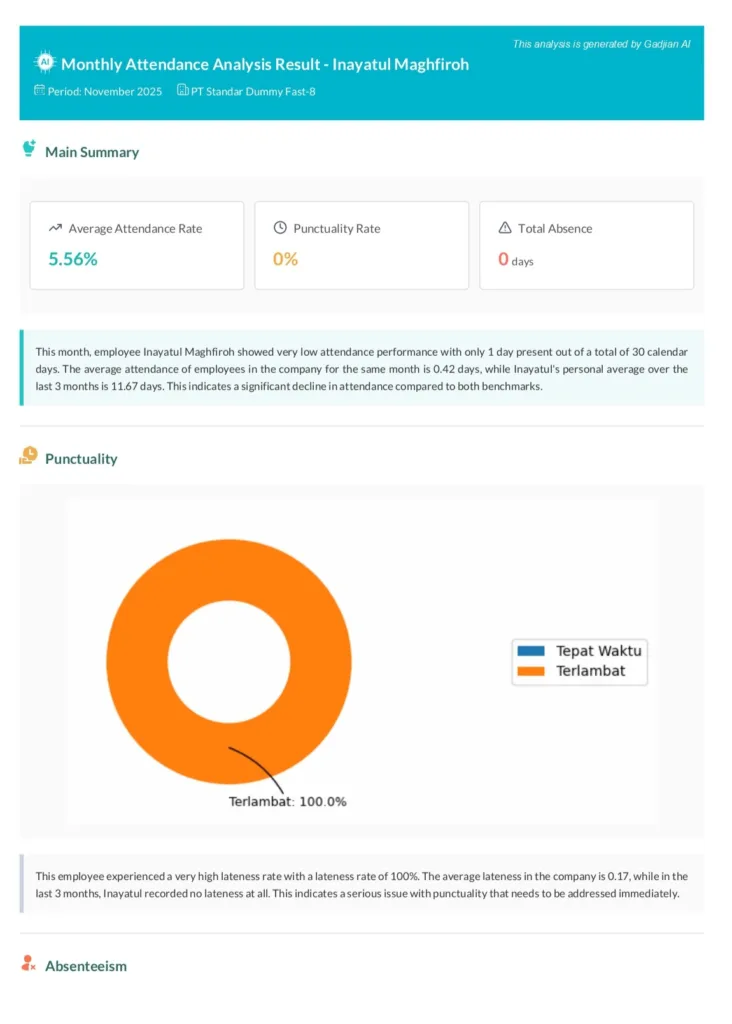
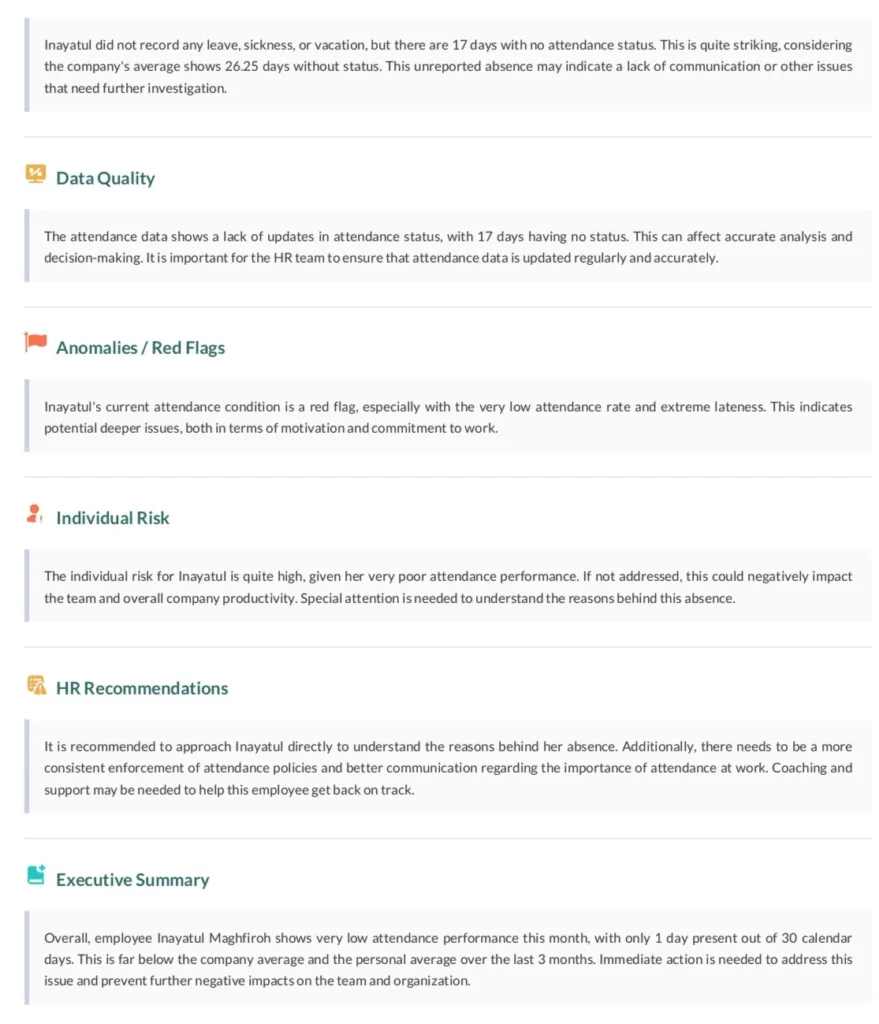
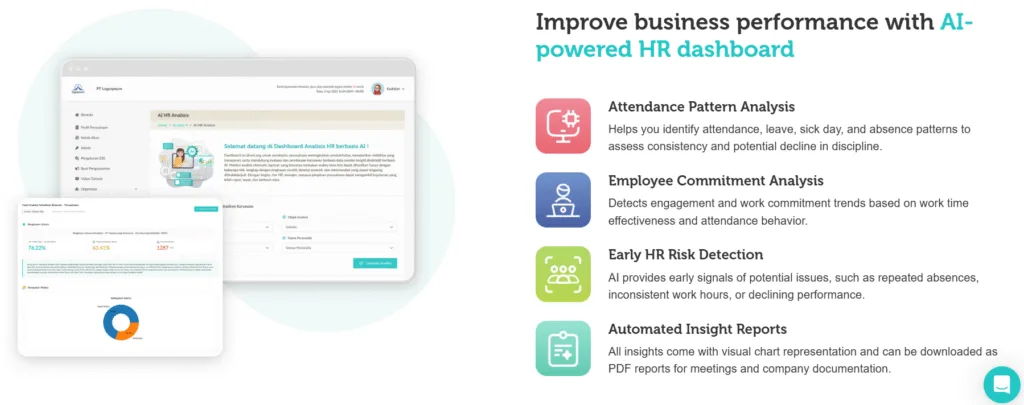
At the core of Gadjian platform is its AI-driven commitment analysis. The system automatically analyzes employee data—attendance, leave patterns, performance records, compensation, and engagement indicators—to identify early signs of disengagement, burnout, or flight risk. Instead of manually reviewing spreadsheets, managers are alerted when patterns start to shift.
In practice, the system delivers:
- Employee commitment scores with trend analysis
- Early warnings for at-risk employees
- Insights segmented by department and role
- Monthly and year-to-date reporting
- Visual dashboards exportable to PDF
- Clear, management-ready insights
The result is less guesswork, faster response, and fewer surprises.
Real-Time Organizational Insights
One of the biggest limitations of traditional HR reporting is timing. By the time quarterly or annual reports are reviewed, the damage is often already done.
Gadjian solves this with real-time organizational analytics. Leaders can monitor workforce health across demographics, compensation structures, productivity indicators, turnover patterns, and department-level performance—without manual data processing. This immediacy matters. Problems are caught while they’re still small and solvable.
Employee Lifecycle Tracking, Not Isolated Metrics
Retention doesn’t happen in isolation, and neither should analytics. Gadjian connects AI retention insights with the full employee lifecycle—from onboarding to development to compensation.
Companies can track early engagement of new hires, monitor performance and promotion readiness, analyze training participation, review attendance and leave patterns, and assess salary competitiveness against the market. When payroll, attendance, performance, and engagement data live in one system, AI can model employee trajectories far more accurately.
That complete picture is what allows the platform to predict flight risk with confidence.
Why Gadjian Works for Retention in Indonesia
What differentiates Gadjian isn’t just technology—it’s context.
First, the platform is built for Indonesia’s regulatory and operational reality. Labor law compliance, regional wage differences, BPJS requirements, and local work culture are already embedded into the system. Your AI retention strategy operates within the rules of the market you’re actually in.
Second, Gadjian is fully integrated across HR functions. Payroll, attendance, leave, performance, and analytics live in one ecosystem. When data flows automatically, AI outputs become more accurate—and far easier to act on.
Third, deployment is accessible. With AI retention analytics available for companies with 15+ employees, even growing startups can use sophisticated, predictive retention tools without enterprise-scale complexity.
Finally, insights don’t stop at prediction. Monthly reports are delivered automatically—complete with commitment analysis, key findings, and visual dashboards ready for management meetings. More importantly, insights flow directly into action: development planning, compensation reviews, workload adjustments, and mentorship decisions.
This is what makes the system practical. It doesn’t just tell you who might leave. It helps you decide what to do next.
With Gadjian, these decisions aren’t driven by gut feel. They’re guided by evidence about what actually keeps your people engaged and committed.
You don’t need a PhD in data science to implement an AI employee retention strategy. Gadjian helps you implement it faster and more efficiently—without adding complexity. Request a demo to start monitoring at-risk employees in your organization.